
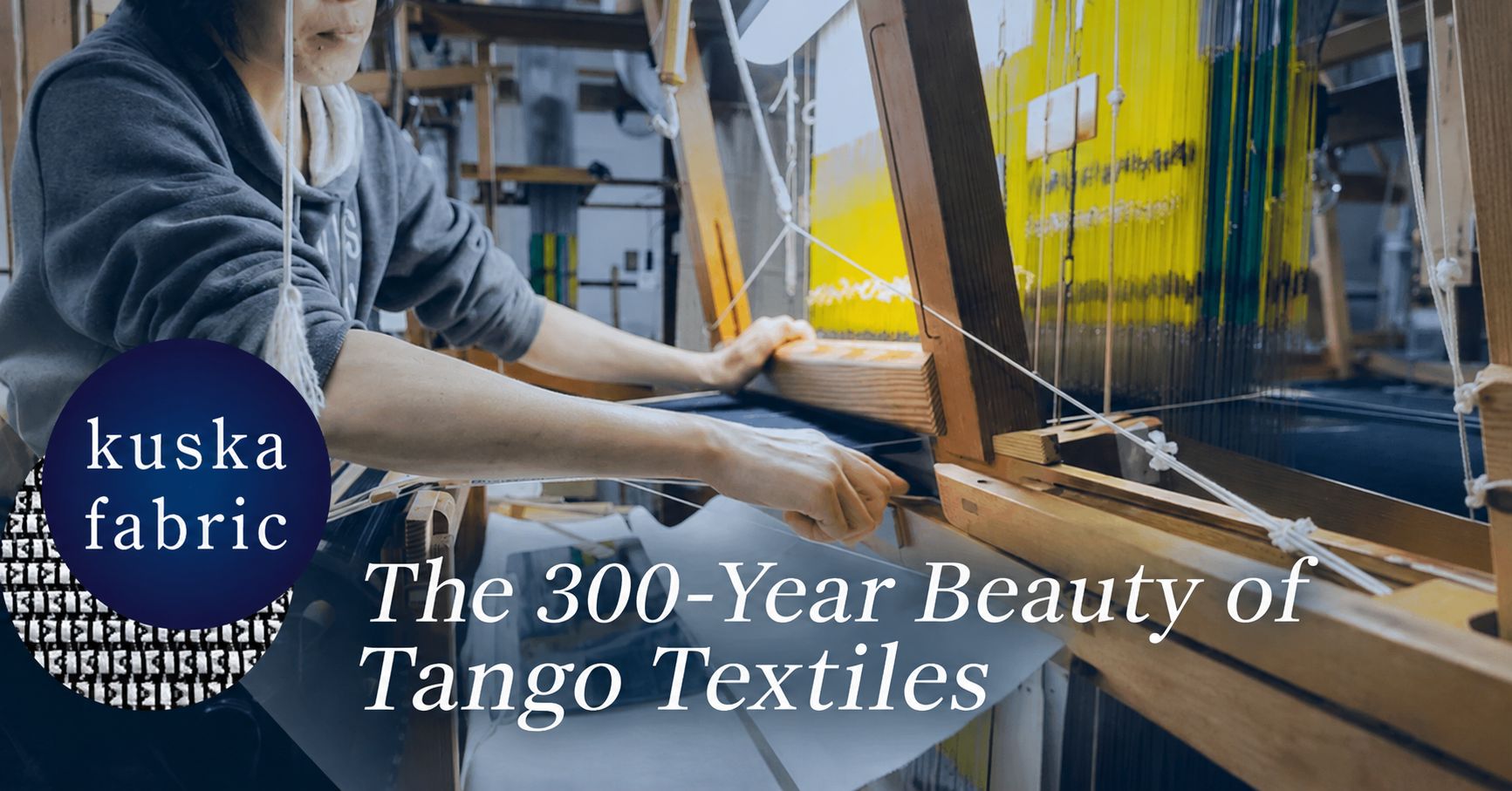
On London’s Savile Row, the storied tailor HUNTSMAN, known for its royal clientele, sells neckties woven with a textile tradition that goes back about 300 years.
They come from kuska fabric, a brand that has collaborated with leading names in Japan and abroad.
How did a Tango textile workshop once on the verge of closing reach this point?
This article visits the kuska fabric workshop, which has modernized Tango’s weaving techniques, and looks at its commitment to quality, the appeal of fabric that only handlooms can make, and the artisans who work there.
It is written for those interested in traditional crafts, as well as anyone looking for a fine necktie, accessory, or bag that reflects their own identity.
kuska fabric, Chosen by Leading Brands in Japan and Abroad


Source: https://kuska.jp/
Tango textiles have been a local industry in the Tango region of northern Kyoto Prefecture for about 300 years.
The region is said to account for about 60% of Japan’s silk textiles and 70% of its kimono production, and its fabric was once essential to many occasions that called for traditional Japanese dress.
The industry once thrived so much that people spoke of “gachaman,” the idea that each clack of the loom (gacha) earned ten thousand yen (man). Falling demand for kimono later brought a long decline.
Yasuhiko Kusunoki, the current president of kuska fabric, brought new energy to this tradition.
The company’s lineup, including neckties with an elegant silk sheen, bags woven from leather, and sneakers, sets it apart from the traditional image of Tango chirimen crepe.
Its neckties are sold at HUNTSMAN, a prestigious tailor on Savile Row, the London street famous for fine menswear. The shop is also known as the inspiration for the tailor in the film Kingsman.
kuska fabric’s handwoven leather was also featured in the BMW X7 Nishiki Lounge, drawing attention as a collaboration between BMW and Japanese master artisans.
In addition, Shinjiro Koizumi wore a Tango-blue tie during the 2024 Liberal Democratic Party leadership election, and many other Japanese politicians have worn kuska fabric ties as well.
The refined sheen of kuska fabric has earned recognition in many fields as a brand that can compete worldwide.
Inside the kuska fabric Workshop

When Yasuhiko Kusunoki became president in 2008, he disposed of all the company’s mechanical looms and switched to handlooms built in-house.
This approach combines the texture that only hand weaving can produce with the productivity of a machine-based mechanism.
What makes Tango textiles woven on a handloom distinctive?
The clacking sound of weaving fills the workshop.


Near the entrance are two rolls of fabric that show the difference.
One feels stiff to the touch, while the other is the smooth white fabric most people associate with silk.
The stiff fabric still contains sericin, a protein found in silk cocoons.
With sericin left in, the fabric has a poor texture, and because the protein is nutritious, insects are more likely to eat it.
It is therefore removed in a process called scouring, which takes away about 20% of the material. Tango chirimen is made from the remaining 80%.

Sericin removed in this process is used in skin lotions and bath additives.
Further inside the workshop, rows of handlooms line the room.
Handlooms That Run on the Jacquard Mechanism

The threads used to weave the fabric are about as fine as a human hair, crossing vertically and horizontally to form the cloth.
Each handloom uses mongami, pattern cards in which holes and solid spaces act like zeros and ones to program the design in advance. Artisans operate the loom up and down to weave it.
This is the mechanism of the Jacquard loom, invented by Joseph Marie Jacquard of France. Its punched-card system is also regarded as an early precursor of binary computer control.
Before this technology reached Tango, looms were raised and lowered entirely by hand. Tango textiles of that era were luxury goods delivered mainly to temples and shrines.

The pattern cards are made by another group of Tango artisans, and each stage of production relies on its own specialists.
The artisans at kuska fabric then use those cards to operate the handlooms.
Craftsmanship That Creates a “Light” Machines Cannot


Hand weaving can be seen up close in the workshop.
The artisan passes a shuttle holding five threads between the warp threads, then steps on a lever to bring the loom down with a clack, adding the weft and forming the weave.
Many small techniques handed down from earlier generations can be seen here.

For example, the shuttle contains lead. The added weight helps it fly smoothly to the far side of the loom.
The five threads wound around the shuttle can loosen along the way, so artisans must constantly watch their condition.

A bamboo tool called a shinshi keeps the woven fabric from pulling inward.
With needles at both ends, it hooks onto the edges of the cloth to maintain its width. Each tool reflects the knowledge of earlier Tango weavers.

The artisan here is weaving Fresco, one of the company’s weaves. Fresco is a type of leno weave, in which warp and weft threads twist around each other.
Machines weave at an extremely high speed, but hand weaving lets air stay within the weave, producing shadow and light and a three-dimensional surface.
This technique draws out the way silk reflects light to the fullest.
Depending on the angle, the color appears to change. The same fabric can look silver from the side and bright white from the front.
A close look at the surface shows each stitch gently raised. Machine weaving would make it completely flat.
Because of this reflection, a gray fabric does not read as a single color. It takes on a complex tone somewhere between silver and black.
Likewise, a vivid blue thread combined with black keeps its brightness while taking on a more subdued color.
Hand weaving also creates differences of a few microns in the size and width of each stitch, and these add up to give the cloth its expression.
This is how each piece gains its refined color and individual character.
“Leave Marital Spats and Family Troubles Away from the Loom”

The expression of a fabric also changes with the day’s humidity and the artisan’s state of mind.
In dry air, threads tend to grow stiff and taut, so weaving takes more force. On rainy days, threads loosen, which makes adjusting that force difficult.
If an artisan is on edge, too much force can crush the weave, and if their mind is elsewhere, the weave can become uneven.
So when artisans sit down at the loom, they first focus their minds.
They have to switch their mood at the loom, even if it takes effort.
One artisan says, “Switching gears can be hard, but when you weave with all your focus you forget the bad feelings, so it may actually make for a better day.”
Weaving that goes well in the morning may change when rain begins in the afternoon and alters the condition of the threads, so there is no room to relax.
“Maybe being a true professional means noticing small irregularities right away and adjusting as you go to finish a good fabric,” the artisan says.
The looms are not always in perfect condition either, and when something goes wrong, artisans repair and adjust them on their own.
Work stops each time, so weavers must patiently care for the loom and gradually make it their own.
Even so, there are many discouraging moments when the fabric will not come out right or the weave keeps wavering.
What is the driving force that keeps artisans improving despite these setbacks?
What Drives the Artisans

One artisan recalls, “One day I saw a customer who had come in wearing a kuska fabric tie, and it suddenly hit me.”
“Until then, what I made was simply a length of fabric to me. But after weaving, it is cut on the bias and becomes a necktie. A customer who likes it buys it, wears it, and makes it part of their identity.”
“When I realized that, I came to understand the meaning of what we make.”
“Thank-you messages from customers and reporters moved by their visits to the workshop also showed me how precious our work is.”
“I grew up hearing the sound of looms and never imagined I would become an artisan who makes that sound myself. That was possible only because those before me carefully protected and passed on these skills.”
“I also realized how wonderful it is to have an environment where they can be handed on to younger generations.”
Today, the artisan finds it rewarding to study and refine these skills alongside colleagues of all generations.
Artisans must maintain high quality at all times, yet they cannot simply repeat the same routine each day. Something that goes well one day may not the next.
The fabric that results from this cycle reflects the skill of creators and artists.
Training Artisans at kuska fabric

Most artisans at kuska fabric start with no weaving experience. Many begin part-time and move to full-time work once their children have grown older.
Because there is an established system for teaching handloom operation and technique, new artisans can complete products within two to three months.
Consistently producing high-quality fabric takes at least two to three years.
Artisans are involved not only in weaving but also in sewing, learning the entire process.
This shows them that every part of the fabric becomes part of a necktie, and that because most steps are done by hand, each one requires care. Their professionalism and skills grow naturally as a result.
According to the company, this work suits people who are drawn to making things and to textiles more than those who see it only as a way to earn money.
As a Japanese proverb puts it, you become good at what you love, and that skill is built through steady effort.
The kuska fabric Product Lineup


kuska fabric offers a variety of items beyond neckties.
For example, its scarves use a type of silk called mawata, which has more volume than regular silk and a soft, cotton-like feel.
The range also includes accessories such as earrings and hairbands, eco bags, leather bags woven from cowhide, and sneakers.

The leather bags are woven on a special loom for leather and finished in Toyooka, Hyogo Prefecture, Japan’s largest bag-producing area.
*Neckties are sold at various stores, but other products are generally sold only through kuska fabric directly.

Inspired by Yasuhiko Kusunoki’s love of surfing, the company also makes a surfboard incorporating kuska fabric’s Tango blue.
Products like this help more people feel close to Tango textiles.

The company has recently begun offering fabric art as well.
The side on display is actually the back of the work, and either side can be shown.
The two faces express the idea of beauty and humanity, which connects to the company’s philosophy of pursuing beauty and humanity.
Kusunoki sees further potential for Tango textiles and hopes to collaborate with painters and artists in the future.
Future Challenges for Tango Textiles

Kusunoki believes that while Tango excels at making textiles, its ability to brand and promote products is still developing.
To build products that fit the market and strengthen its promotion, kuska fabric continues to entrust design and PR to professionals in each field.
This approach of relying on experts in each field also reflects respect for their work.
The view that a viable business must make things people want rather than stop at self-satisfaction may apply to every traditional craft seeking to survive.
Visiting kuska fabric


The exterior of the building shows animals surfing on the waves of Tango. The monkeys, deer, and crabs depicted are all animals found in Tango.
This wall art is by the artist 210, a native of Kumihama in Tango. The large white area visualizes garza (a leno weave), one of kuska fabric’s signature weaves.
The work brings a traditional industry and contemporary art together in one piece.
kuska fabric is recognized for the distinctive, luxurious feel of its three-dimensional fabrics and has grown into an internationally known brand.
This growth reflects Kusunoki’s belief that Tango’s hand-weaving techniques could meet the needs of people seeking authentic quality and stand alone in the world.
According to the company, kuska fabric is currently the only company in Tango that weaves by hand, making these techniques an important part of the region’s appeal.
kuska fabric Basic Information


| kuska fabric tango factory shop (Tango, Kyoto) Address: 384-1 Iwaya, Yosano-cho, Yosa-gun, Kyoto Prefecture Phone: +81-772-42-4045 Hours: 10:00 a.m. to 5:00 p.m. Closed: Sundays (and on irregular days; see the calendar) Official website: https://kuska.jp/en/ Email: info@kuska.jp Instagram: https://www.instagram.com/kuska1936/ |
| kuska fabric flagship shop (Imperial Hotel Tokyo) Address: Imperial Hotel Tokyo Basement Arcade, 1-1-1 Uchisaiwaicho, Chiyoda-ku, Tokyo Phone: +81-3-6205-7822 Hours: 10:00 a.m. to 7:00 p.m. Closed: Follows the facility’s closing days Email: shop@kuska.jp |
For information on stores that carry kuska fabric, see the official shop list (Japanese).
Customers who have purchased products can tour the workshop.
Custom orders are also available. Neckties take about two to three months to make. Please inquire about other items.