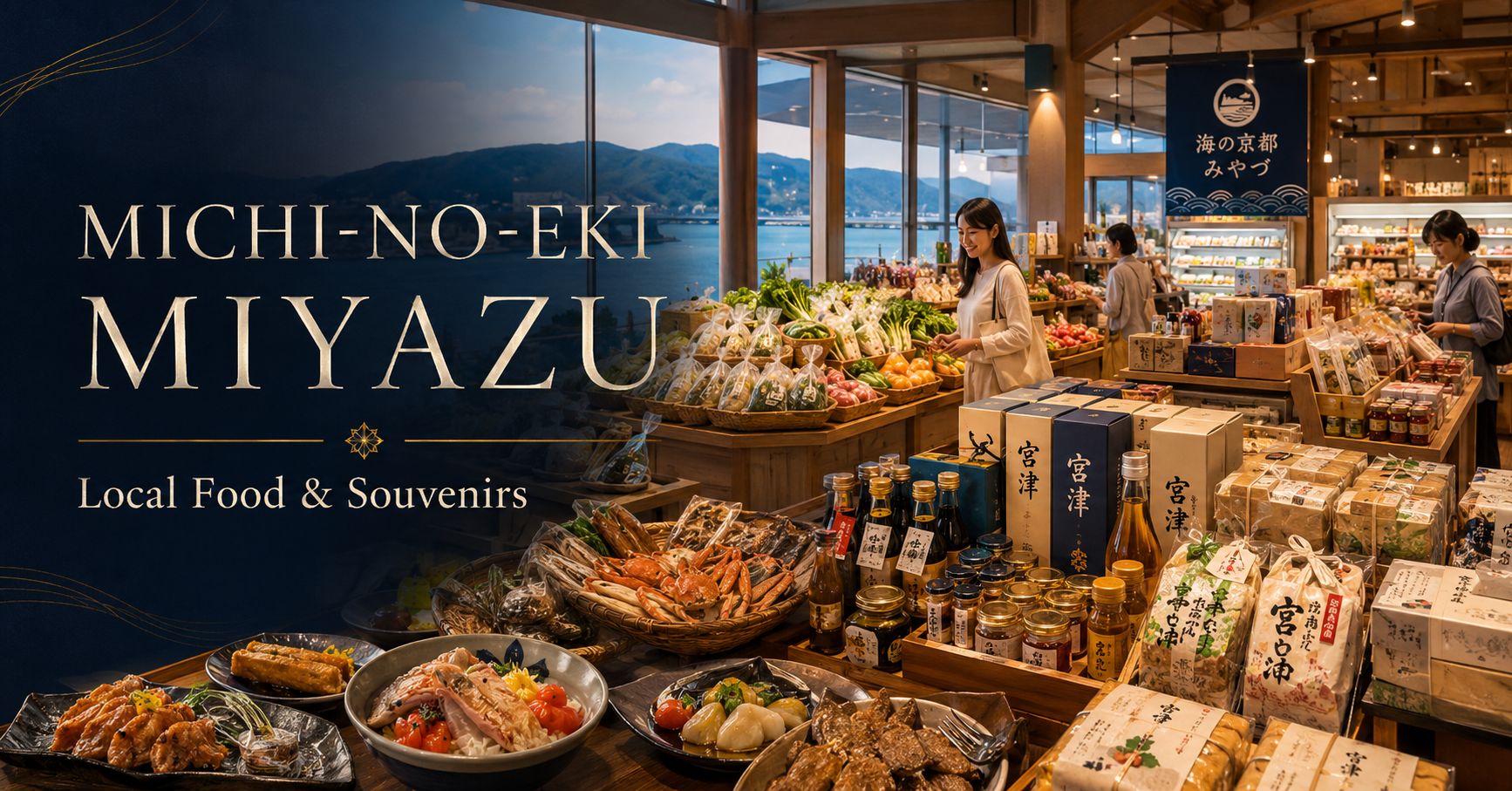
Michi-no-Eki Umi-no-Kyoto Miyazu is known as the roadside station closest to Amanohashidate.
It houses the area’s tourist information centre, Miyazu Magokoro Ichi — a market of local produce, seafood and souvenirs — and Osakana Kitchen Miyazu, where you can eat very well from Tango ingredients.
We visited in person to ask about the souvenirs worth buying, the items you can only get here, and what makes Miyazu’s produce special.
If you have a weakness for unusual or limited-edition souvenirs, or you want to know what local people actually eat, read on.
What Is Michi-no-Eki Umi-no-Kyoto Miyazu?
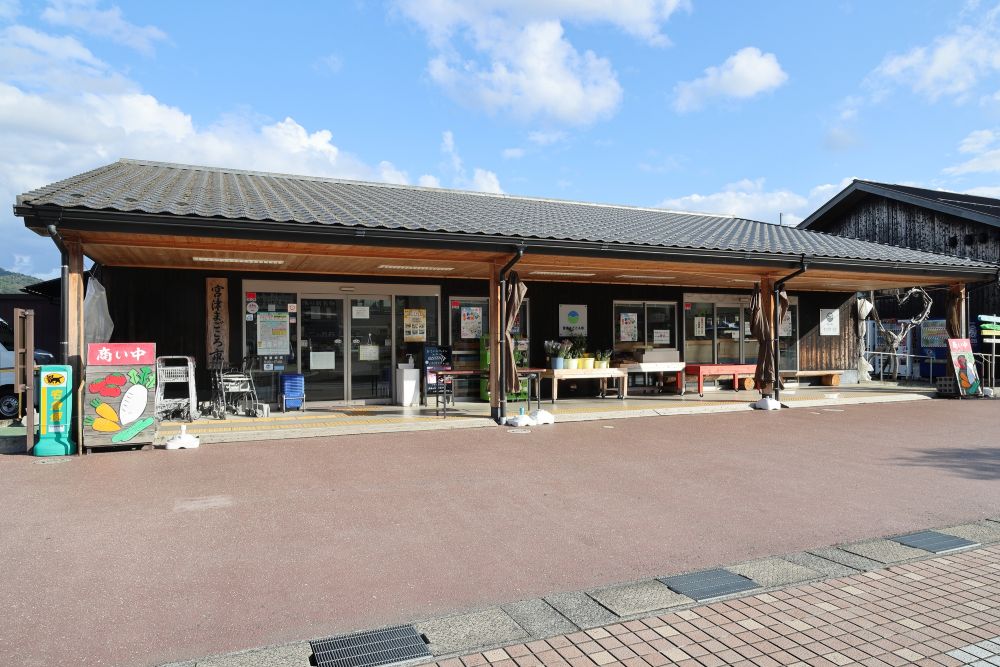
Miyazu Magokoro Ichi is, in effect, Miyazu’s kitchen.
Almost all of the vegetables, fruit, rice, sweets, seafood and meat on sale come from Miyazu itself.
There is some game and beef from the wider Tango area, but the market is strict about selling Miyazu produce, so it is fair to say the appeal of the whole area is gathered in one room.
Osakana Kitchen Miyazu, meanwhile, builds its menu around Miyazu ingredients, which makes it a good stop for lunch or a light meal.
Some dishes use ingredients you would struggle to find anywhere else, so it is an easy way to try something new.
[Shopping] Miyazu Magokoro Ichi
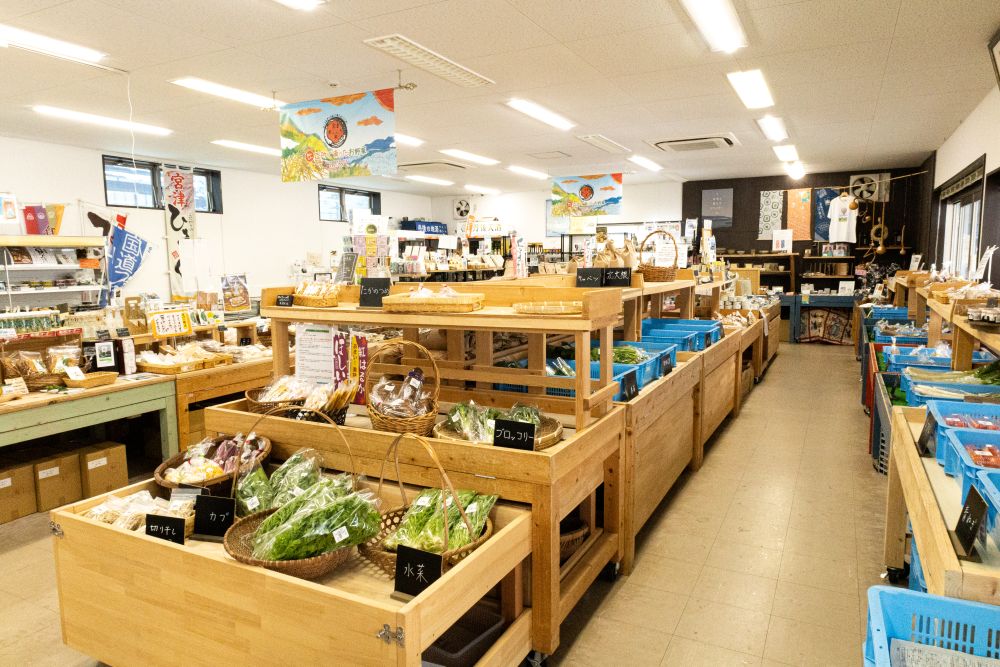
Let us start with the ingredients and souvenirs worth looking for at Miyazu Magokoro Ichi.
Sweets and Confectionery Made with Local Pride
Many of the sweets here are so prettily packaged that you want to buy them on sight. Each one carries something of its maker’s affection for the area.
Amanohashidate Cheesecake
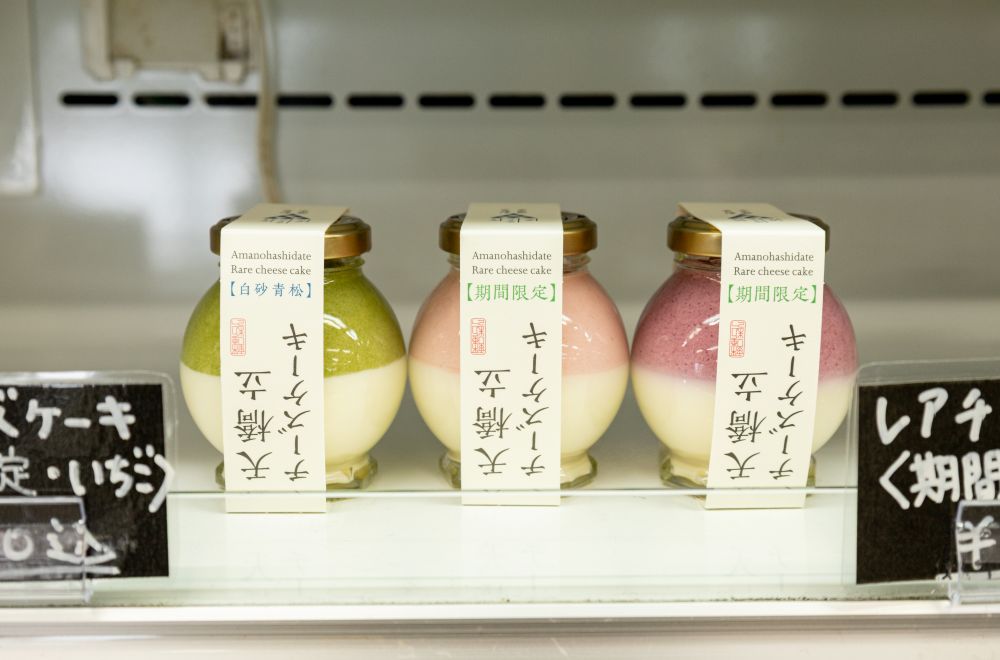
The label on the Amanohashidate Cheesecake is printed upside down — a nod to matanozoki, the local custom of viewing the sandbar bent over and looking back between your legs.
The rounded jar is shaped after the Chie-no-Wa, the “ring of wisdom” monument nearby. It is a lovely object in itself.
It is hard to see in the photo above, but the words “mada fumi mo mizu” are printed at the top of the label.
The phrase comes from a poem about Amanohashidate by Koshikibu no Naishi, a Heian-period poet, and it is familiar to everyone in Miyazu.
Mada Fumi mo Mizu is the original brand of Hamakaze Project Co., Ltd., which also runs Miyazu Magokoro Ichi.
Like the poem, the brand was born from a wish to act as a “fumi” — a letter — carrying the good things of Miyazu to people who have not yet set foot here.
Flavours include the standard version made with matcha from Isono Kaikado, a long-established Miyazu tea shop, plus seasonal editions such as strawberry.
Koshikibu no Naishi’s poem — a story that still lands in a modern workplace
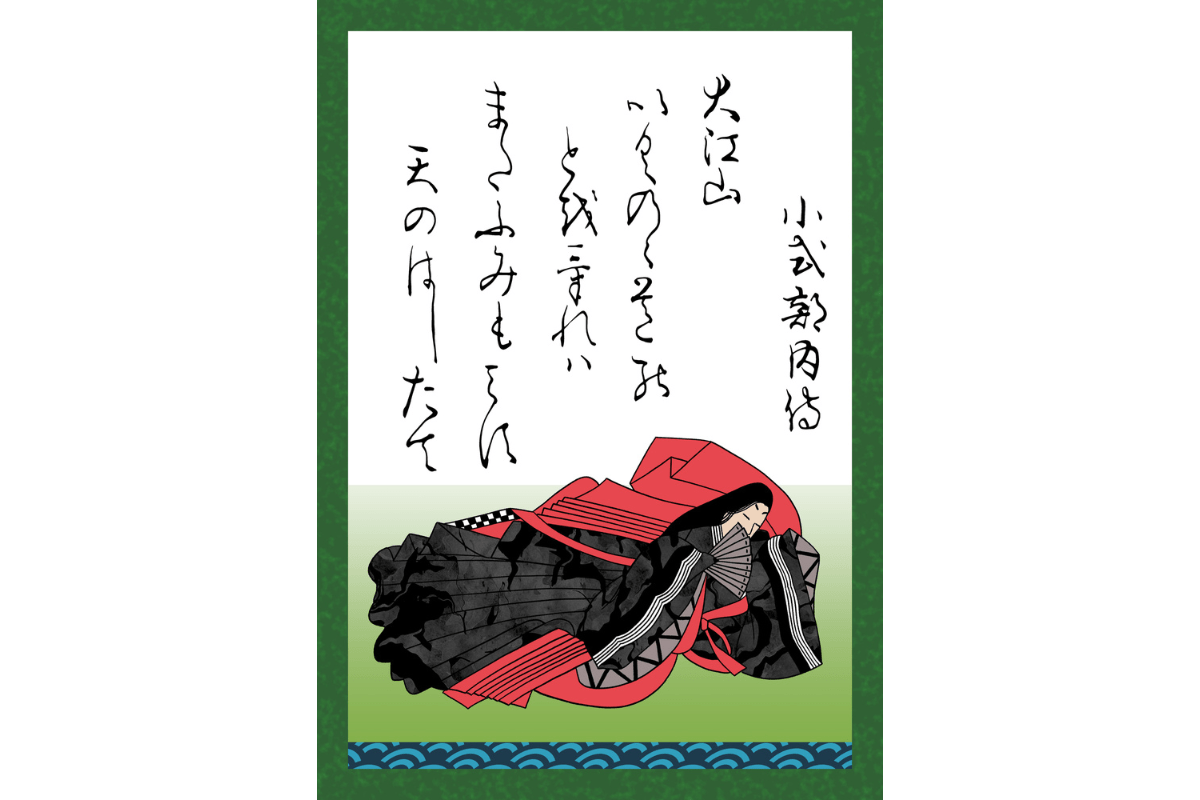
The poem Koshikibu no Naishi composed about Amanohashidate became famous as proof of her talent.
She was known for writing accomplished poetry from a very young age — so accomplished that people whispered her mother, the poet Izumi Shikibu, must be writing it for her.
So when Koshikibu no Naishi attended a poetry gathering alone, Fujiwara no Sadayori, who was also present, needled her: “And how will you compose here? Has your messenger not come back from your mother yet?”
This was her reply.
In the poem, iku no no michi puns on Ikuno, a place name, and iku, “to go”; fumi mo mizu puns on “without setting foot” and “without seeing a letter”.
By producing both puns on the spot, she proved that the poems were hers and not her mother’s work.
Fujiwara no Sadayori, the story goes, was so taken aback that he left without managing a reply.
The episode became well known and is quoted in the Hyakunin Isshu, the Kin’yoshu and many other anthologies, tales and scholarly works.
There is something in it that still rings true in a modern office — a sharp junior and a superior who cannot resist a dig.
(Source)
https://mada-fumimomizu.kyoto/
https://ogurasansou.jp.net/columns/hyakunin/2017/10/17/1314/
Amanohashidate Candy
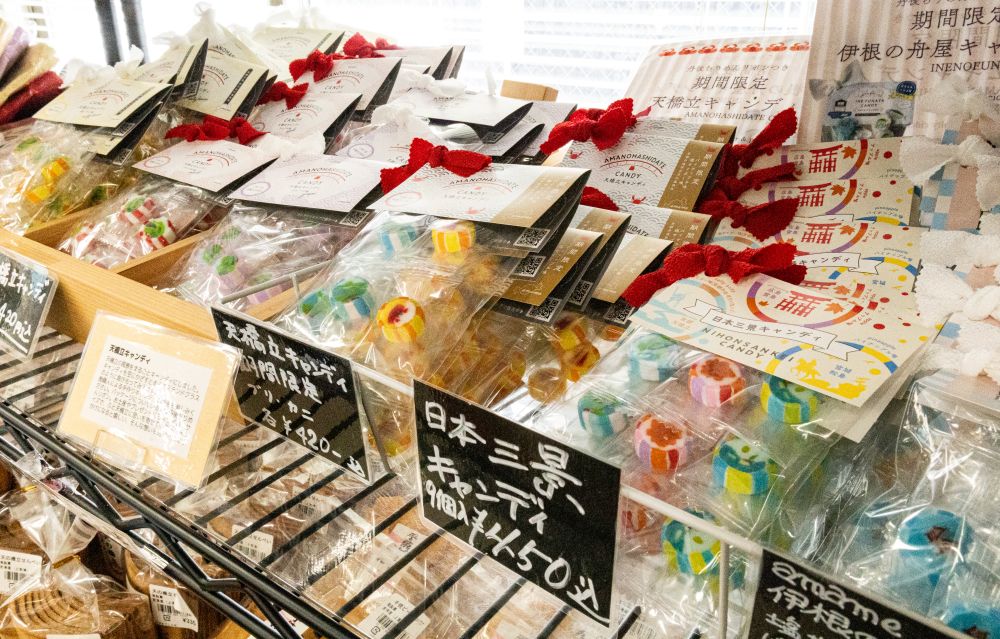
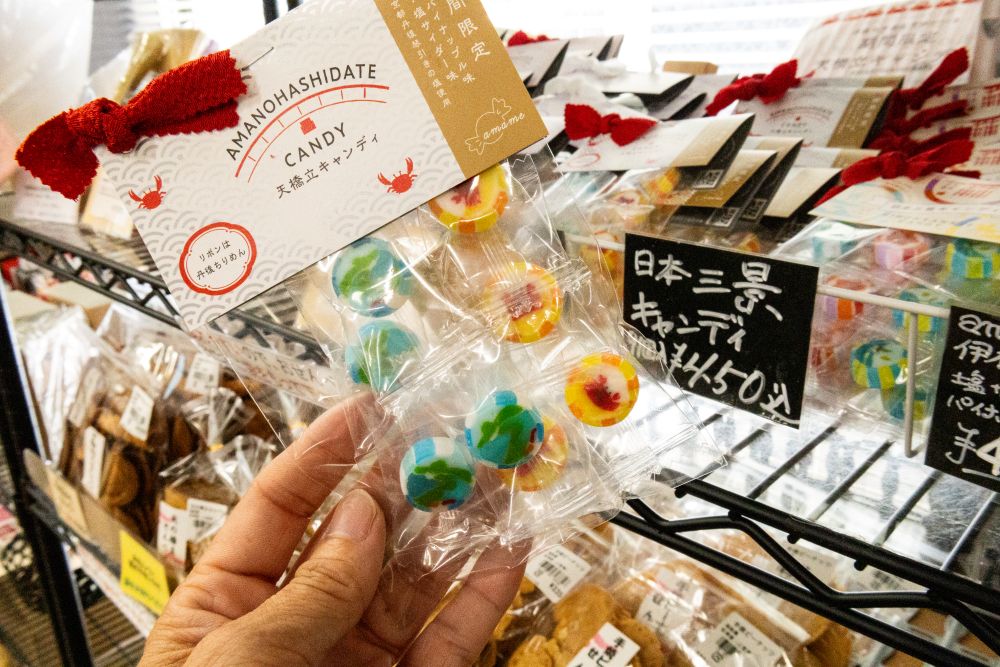
This is another Amanohashidate staple: Amanohashidate Candy.
Built on the idea of “eating the view”, these sweets pack the appeal of the Amanohashidate area into a tin.
Alongside Amanohashidate Candy, which pictures the sandbar and Taiza crab, there is Nihon Sankei Candy, featuring Miyajima in Hiroshima and Matsushima in Miyagi as well as Amanohashidate, and Ine no Funaya Candy, with yellowtail and the boat houses of Ine.
Since Taiza crab and yellowtail are winter foods, those designs are winter-only.
Some flavours use Kotohiki salt from Tango, and the ribbon on the left-hand edge is Tango chirimen silk. There is enough Miyazu in one tin to tell the whole story, which is exactly what you want from a souvenir.
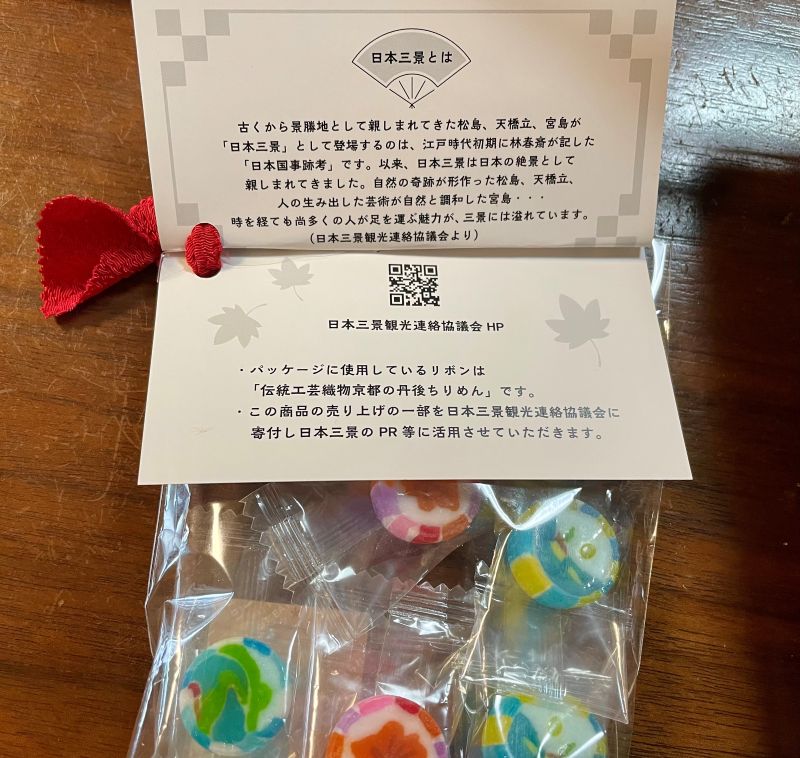
Inside the Nihon Sankei Candy box there is a note explaining that part of the proceeds goes towards promoting Japan’s three great views.
Supporting not just Amanohashidate but the other places Japan has treasured for centuries is a fine touch.
(Source)
https://note.com/fb_selection/n/nf0c90accb53c
The Senbei Rice Cracker Range
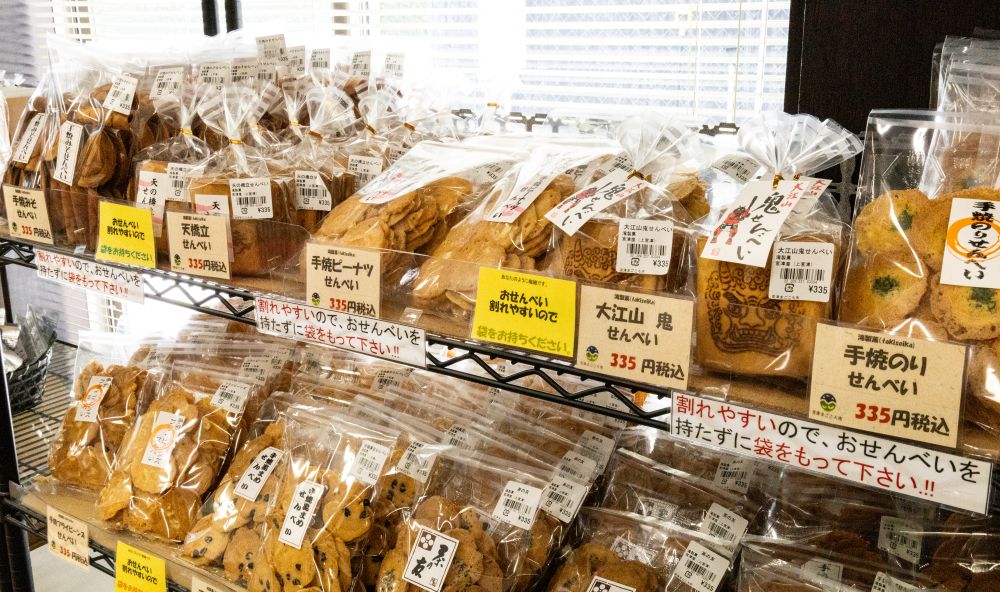
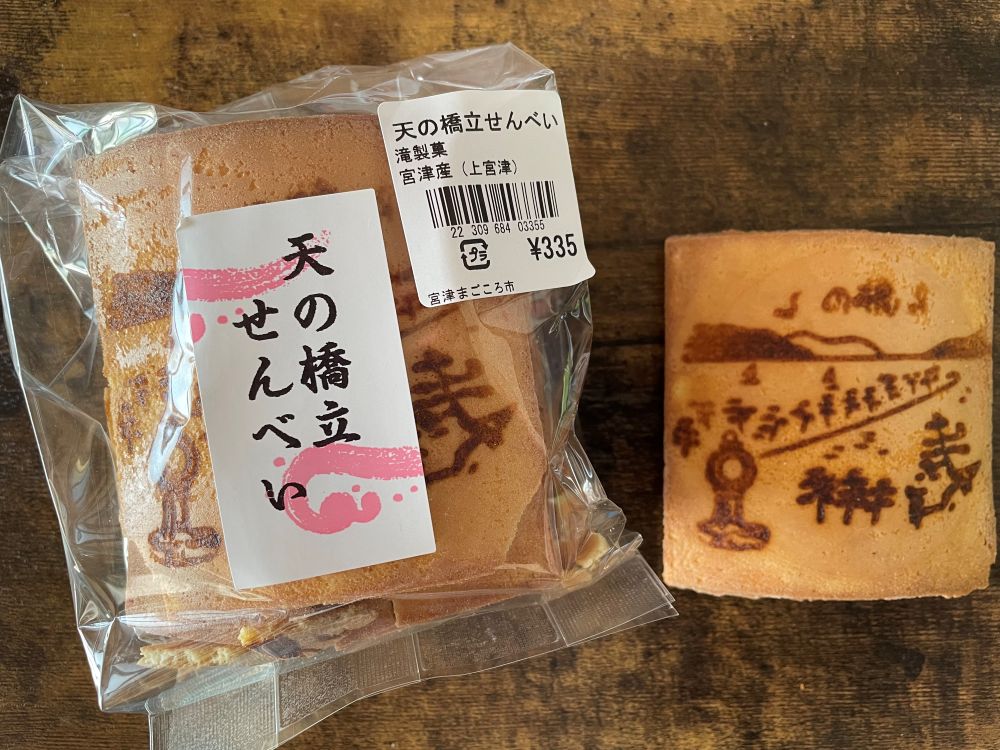
Handmade, with the plain, honest flavour that makes a good senbei.
The designs are drawn from the area: Amanohashidate Senbei, showing the sandbar and the Chie-no-Wa monument, and Oeyama Oni Senbei, with a suitably fearsome ogre of Mount Oe.
The sweetness is gentle, so they suit anyone who likes simple flavours — and they work well as a snack for children.
Hosokawa-ke Binan Pudding & Bijo Pudding
Tango has a famous married couple in its history.
In 1580, Hosokawa Fujitaka was granted the province of Tango by Oda Nobunaga, and lived quietly here with his son Tadaoki and Tadaoki’s wife Hosokawa Gracia, admiring Chion-ji temple and Amanohashidate.
Everything changed in 1582, when Oda Nobunaga was attacked and took his own life in the Honno-ji Incident. Gracia was the daughter of Akechi Mitsuhide, the man who had turned on Nobunaga, and she spent the years that followed confined and in hardship.
Hosokawa Tadaoki and Hosokawa Gracia are remembered as a couple who lived through violent times — and both were famous for their good looks.
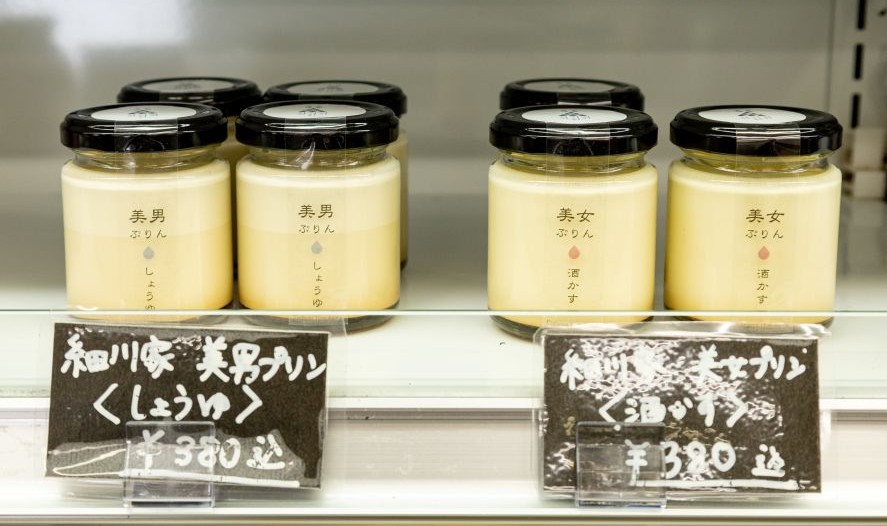
The Hosokawa-ke Binan Pudding (handsome man) and Bijo Pudding (beautiful woman) are modelled on them.
In Japan people sometimes sort faces into “soy-sauce” and “salt” types, and the Binan Pudding is soy-sauce flavoured. Perhaps Hosokawa Tadaoki had that look: a small face, soft features, thin lips.
The Bijo Pudding is made with sake lees and modelled on Hosokawa Gracia — developed on the thought that the beauty benefits of sake lees might make you as lovely as she was.
Wrapped in the soft aroma of sake lees, with the rich depth of egg and milk behind it. A very good pudding.
Have you ever eaten sake lees?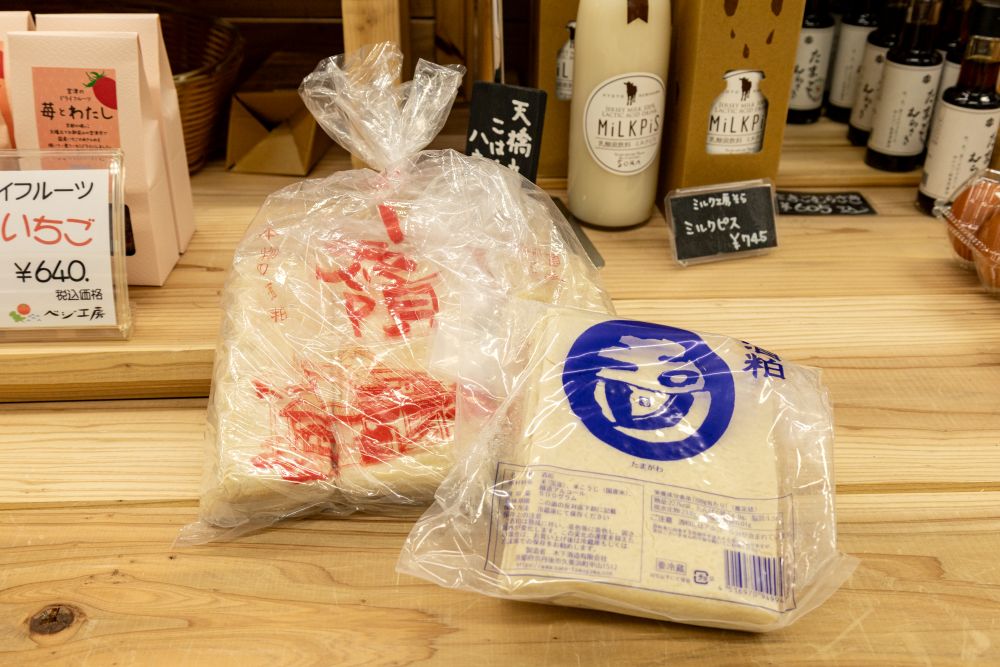
Sake lees, or sakekasu, are what remains after pressing during sake production. Made from rice and rice koji, they are packed with nutrients derived from the yeast — carbohydrates, protein and vitamins.
They do contain alcohol, so children and anyone sensitive to it should take care. Dissolved into miso soup they add real depth, and combined with water, sugar and ginger they make an excellent amazake.
They improve circulation, so they warm you from the inside. It is also interesting to compare how the flavour differs from one brewery to the next.
(Source)
https://www.kyotoside.jp/entry/20210123/
https://www.kyotango.gr.jp/gracia-midono/
https://chomiryo.takarashuzo.co.jp/knowledge/detail/116/
https://magazine.asahi-shuzo.co.jp/know/166#item6892
https://woman.mynavi.jp/article/190828-11/2/
A Different Level of Freshness: Vegetables and Fruit
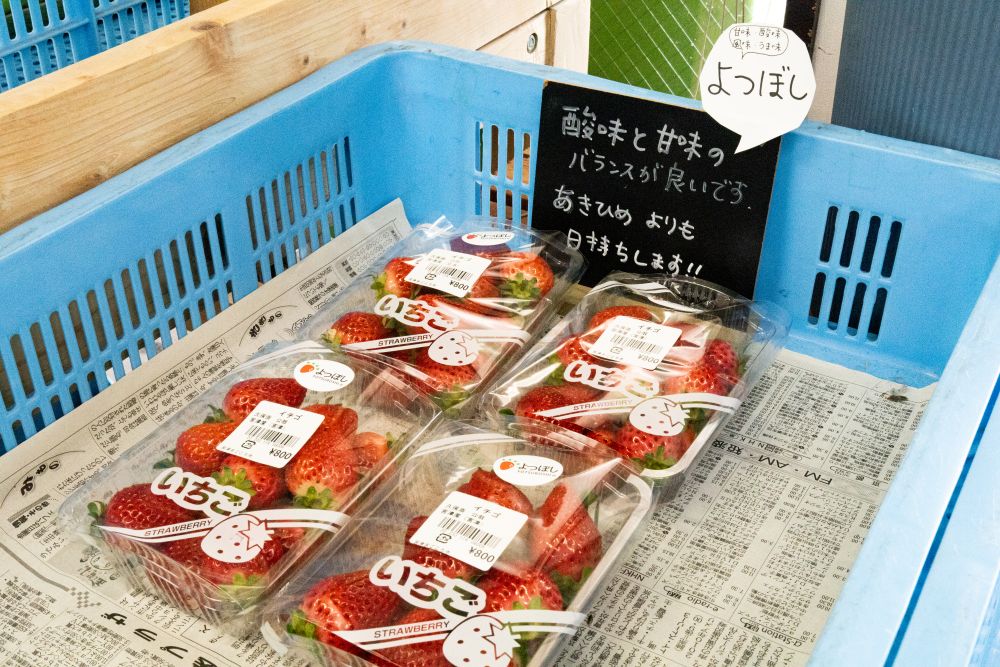
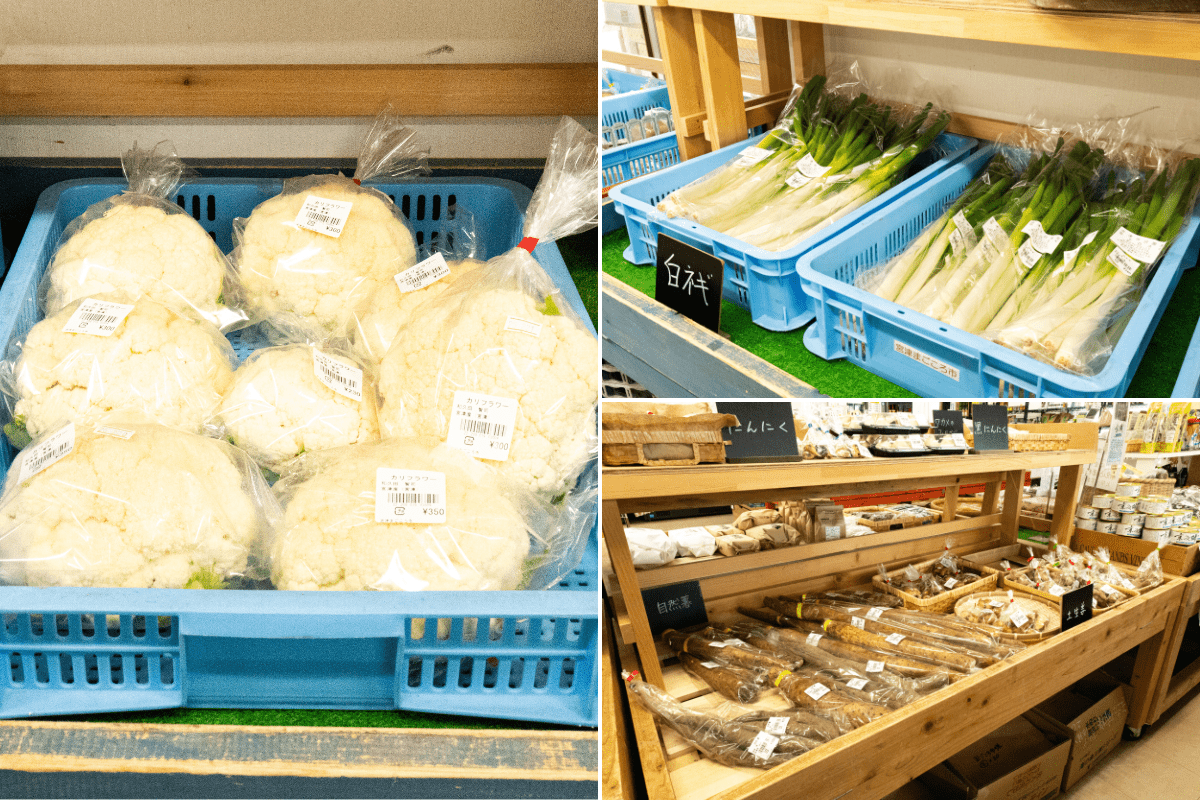
In Miyazu the mountains and the sea sit very close together. Because of that geography the water is exceptionally clean, and vegetables grown on it are lively and full of moisture.
Miyazu Magokoro Ichi sets strict standards on pesticide use and sells only vegetables that meet them.
Right now the picks are white leek, turnip and Chinese cabbage.
The white leek is sweet enough that some people make the trip specially to buy it.
The Chinese cabbage is so fresh you can see it the moment you cut into it. People say it ruins you for the supermarket version.
Also worth a look: large, dense broccoli and cauliflower, and jinenjo wild yam, which you rarely see in a supermarket.
In winter, do not miss the Yotsuboshi strawberry, which has sweetness, depth, acidity and aroma all at once. The flesh is firmer and less watery than other varieties, so it keeps well too.
Seafood That Works in Any Number of Dishes
Miyazu lands a great deal of seafood, and the knowledge of how to make fish last has been handed down here for generations. There is no shortage of versatile seafood products that work in all sorts of dishes.
Takenaka Kanzume Oil Sardines
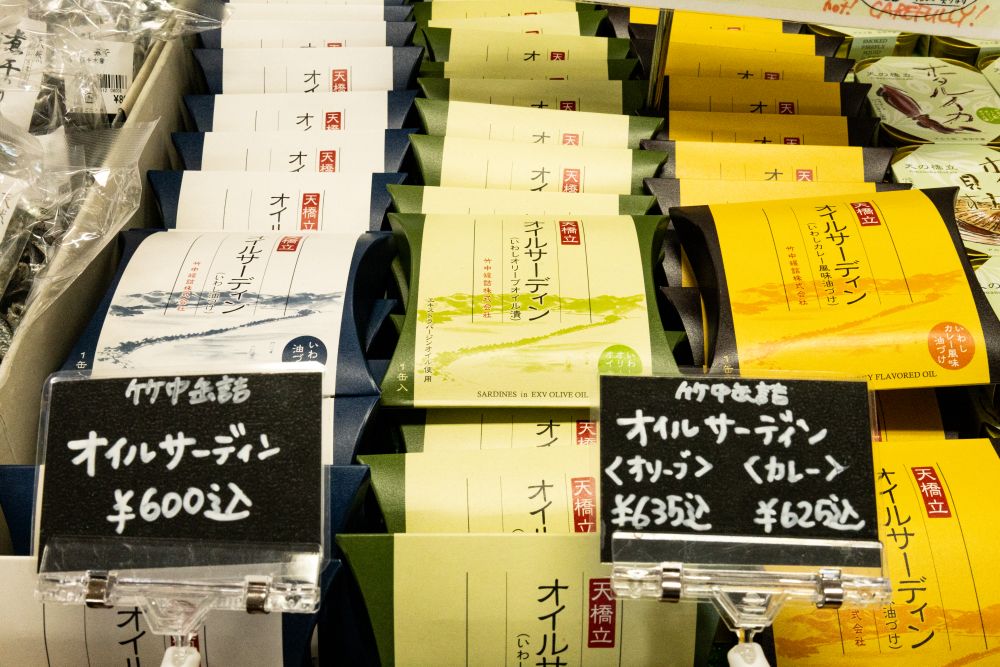
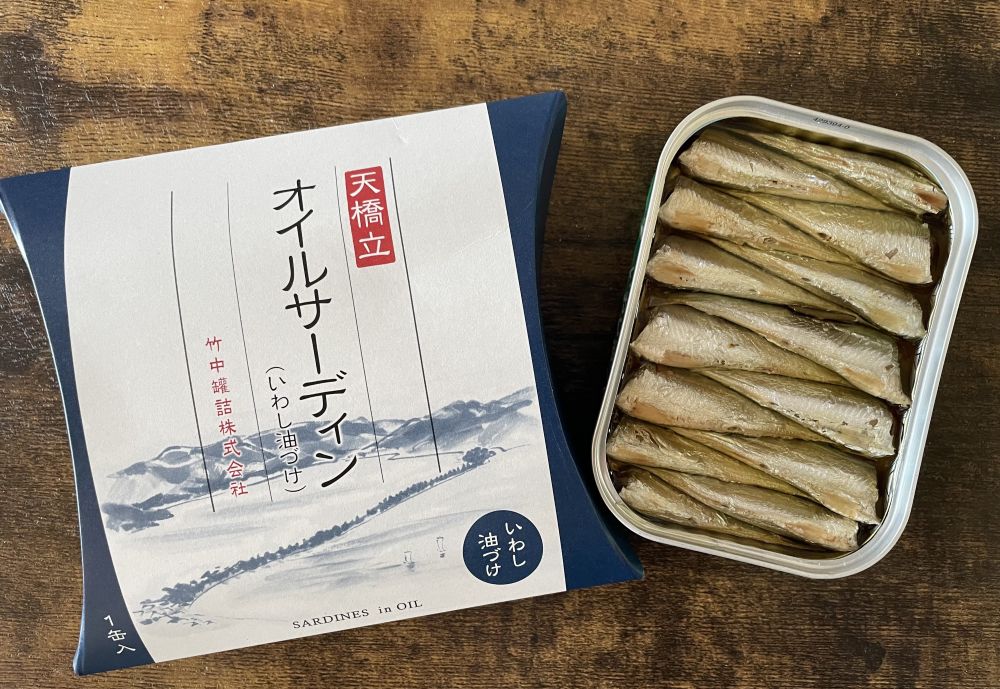
You cannot talk about Miyazu souvenirs without Takenaka Kanzume oil sardines.
Oil sardines are sardines with the innards removed, packed in oil.
At Takenaka Kanzume every step is done by hand, from preparing the fish to sealing the tin, and the sardines are packed in cottonseed oil or fresh extra virgin olive oil.
You can see the care in the packing the moment you open the lid — it really is a lovely thing to look at.
Alongside the standard tin, Miyazu Magokoro Ichi carries limited olive oil and curry-flavoured oil versions.
Those two are exclusive to Miyazu Magokoro Ichi.
Recipe ideas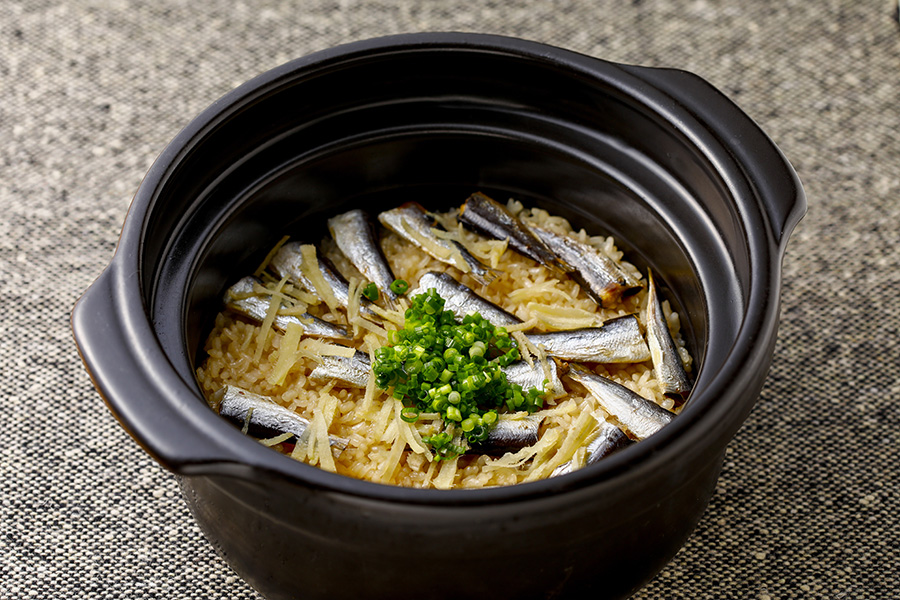
Source: https://takenaka-kanzume.co.jp/recipe/108/
Straight from the tin with a drink, of course, but they also work in takikomi gohan, nanban-zuke sardines、potato salad and pasta. Add mushrooms and a dried chilli and heat it through, and you have an easy, excellent ajillo.
There are more recipes on the Takenaka Kanzume website.
(Source)
https://takenaka-kanzume.co.jp/recipe/108/
https://cookpad.com/jp/recipes/21610733
Saba Heshiko (Rice-Bran-Cured Mackerel)
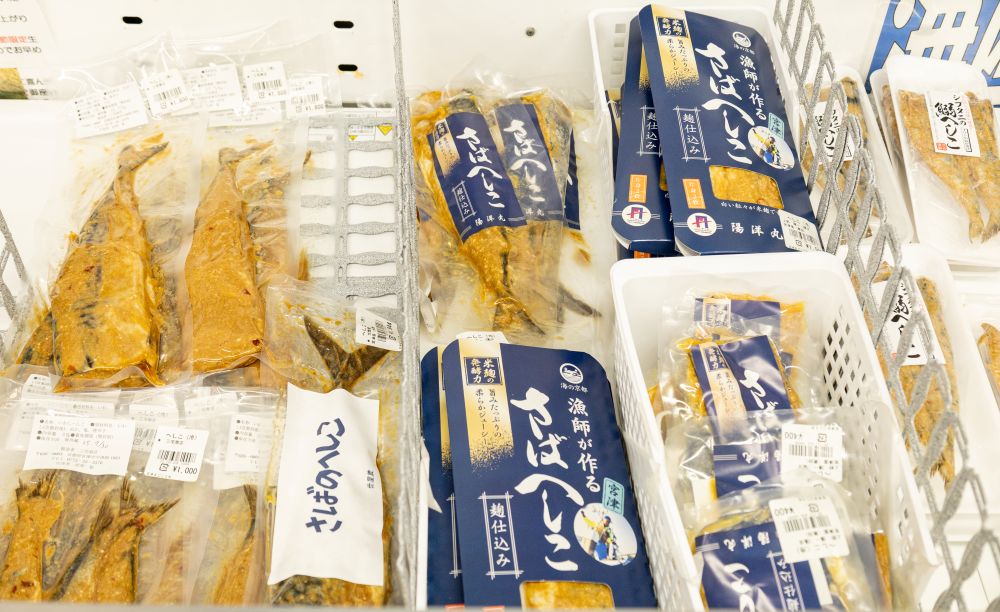
Heshiko is a traditional Tango dish: oily fish such as mackerel cured in rice bran.
Fermenting fatty fish in the bran deepens its savour and brings out a sweetness.
Salting and packing in bran was how people kept oily fish, which spoils quickly, edible for months.
The name is said to come from heshikomu, the fishermen’s word for pressing the fish down into a barrel of bran. (There are other theories.)
Every producer uses a slightly different balance of bran, salt and seasoning, so the flavour varies. Locals tend to have a favourite: “we like the heshiko from this one.”
The heshiko from Hamabun Shoten is especially popular and often sells out, so buy it if you are lucky enough to find it.
Recipe ideas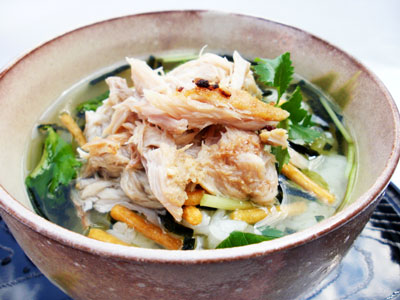
Source: http://hamabun.net/hesiko-himono.html
Brush a little of the bran off the heshiko and grill it, or use a toaster oven. Leaving some bran on keeps the flesh juicy. Eat it as it is with rice, or flake it into ochazuke, fried rice or pasta — all good.
It is salty, which makes it an excellent drinking snack.
You can also blitz it with basil and olive oil into a “heshiko genovese” sauce for pizza or pasta.
(Source)
https://www.city.miyazu.kyoto.jp/site/citypro/12578.html
https://www.city.miyazu.kyoto.jp/site/citypro/11049.html
Ugo Seaweed
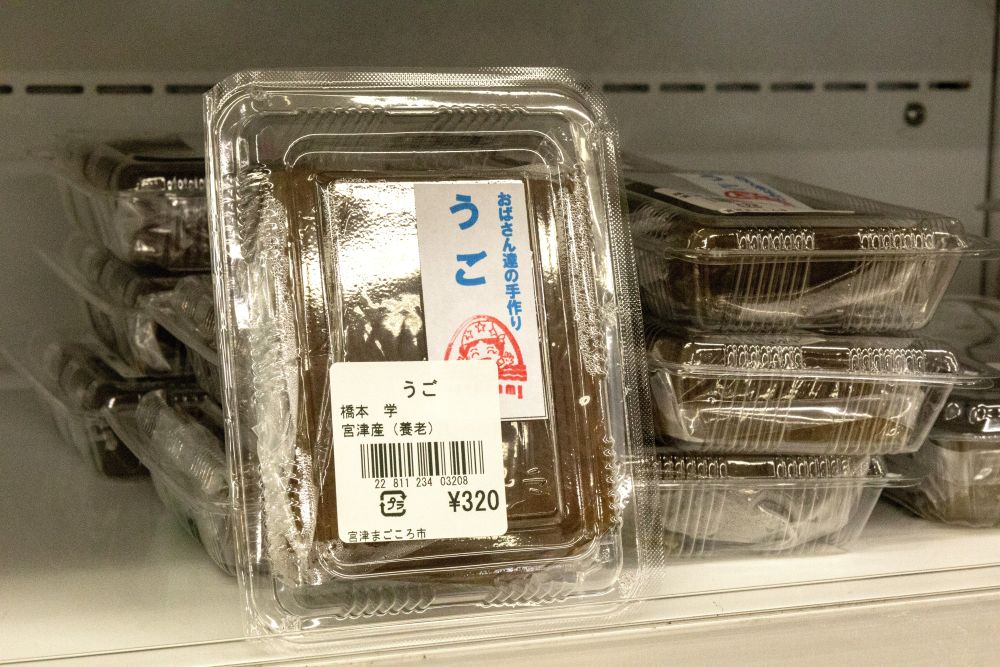
Ugo is the Tango name for a seaweed called egonori.
Preparing it takes time and effort. The result carries a soft scent of the sea, with a springy bite and little pops of texture running through it.
The standard way to eat it is with ginger soy sauce and spring onion, though households vary: some use sugar, sesame and soy sauce, others fold it into tofu as shiraae.
It was originally a ceremonial dish, served when people gathered for celebrations or Buddhist observances. It is harvested around July, so it tends to be eaten through the hot part of the summer.
Catches have fallen year on year and there are fewer fishermen, so fewer places sell it now. It is a healthy food made from seaweed, and well worth trying for the texture and the flavour alone.
(Source)
https://slowfood-nippon.jp/ugo/
https://www.nhk.or.jp/kyoto/lreport/article/003/84/
https://www.city.miyazu.kyoto.jp/site/citypro/13099.html
Akamoku Seaweed
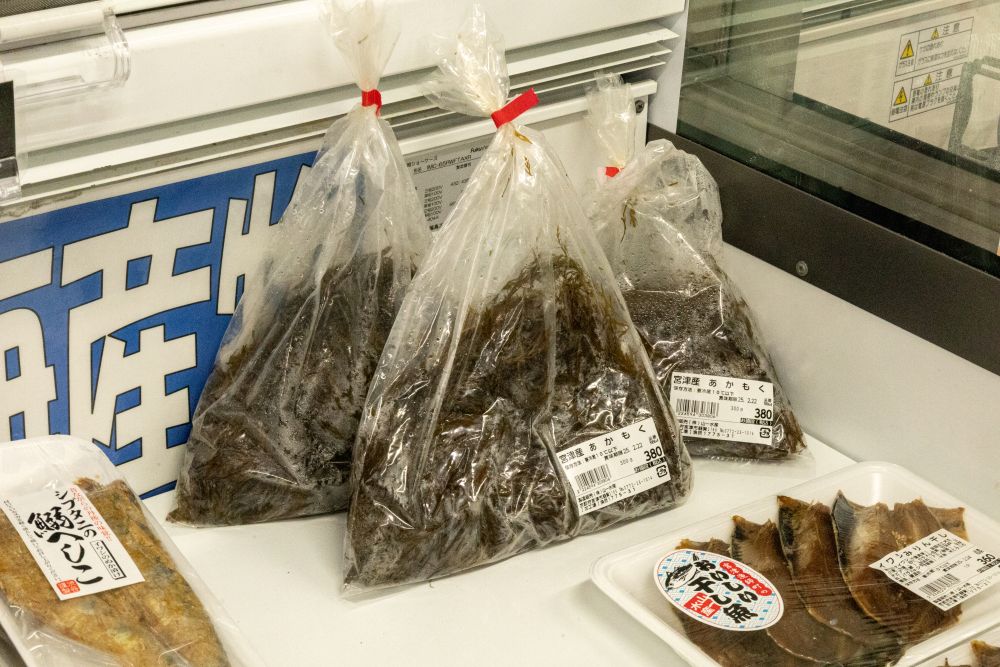
Akamoku is a seaweed harvested in Miyazu Bay, and something of a power food: rich in potassium, calcium and magnesium.
In Miyazu it used to be called jamamoku — “nuisance weed” — because it tangled in boat propellers and got in the way of fishing. Now that its nutritional value is known, demand has risen and it is farmed to keep supply steady.
Blanch it and eat it with ponzu like mekabu, add it to pasta or miso soup, or combine it with okra and natto for a neba-neba bowl. There is no shortage of ways to use it.
Perhaps the reason so many people in Miyazu look so well is that seaweed is part of the everyday diet here.
(Source)
https://www.city.miyazu.kyoto.jp/site/citypro/13099.html
Miyazu Is Full of Sake Breweries, and the Range Shows It
Where the seafood is good, the sake matters. Miyazu Magokoro Ichi stocks Tango sake and some genuinely unusual things to drink it with.
Pin Cup & Tokkuri Ika
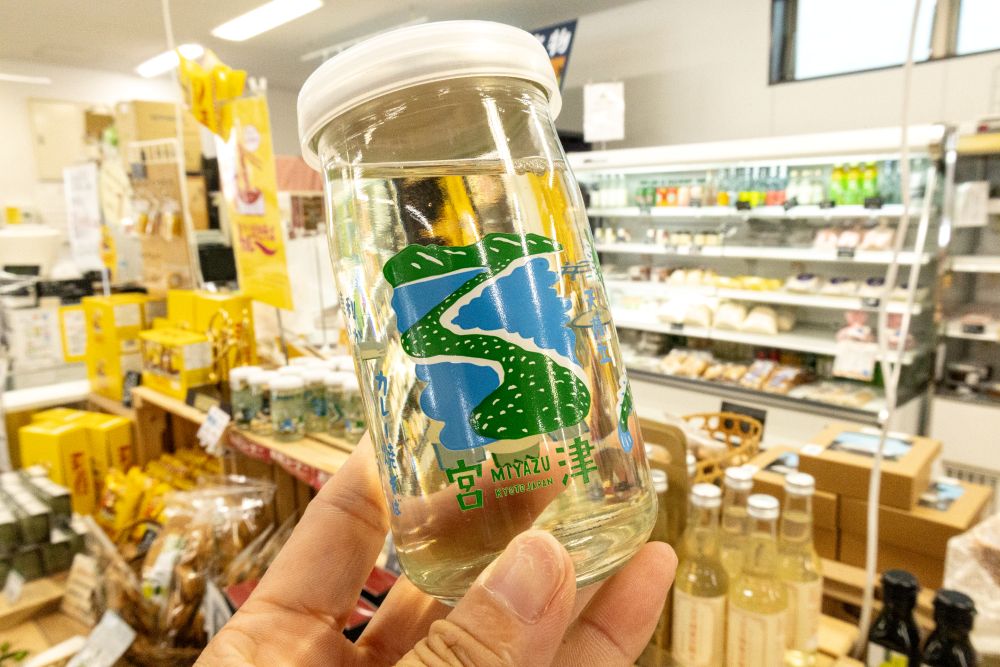
One that has drawn attention in recent years is Pin Cup, a cup sake filled with sake from Hakurei Shuzo.
The glass is printed with things that stand for Miyazu: the sandbar, the matanozoki pose, oil sardines, Chie-no-Mochi rice cakes, curry yakisoba.
Even if you do not usually drink sake, packaging this charming is hard to walk past.
The “pin” in Pin Cup comes from the Miyazu-bushi folk song sung at the local Bon dance: Tango no Miyazu de pin to dashita.
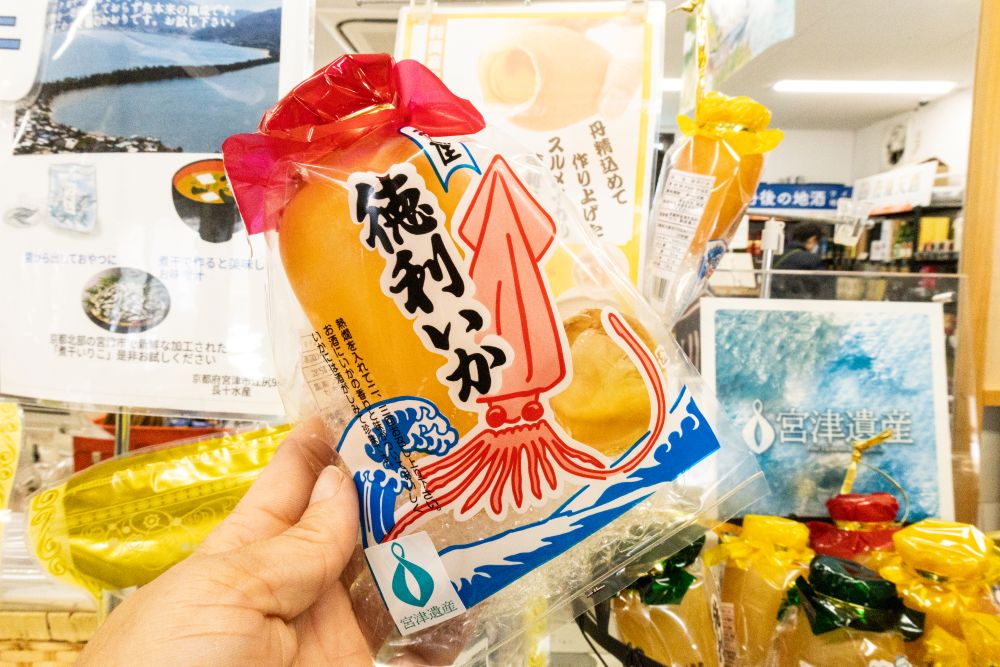
And then there is Tokkuri Ika, a Miyazu speciality.
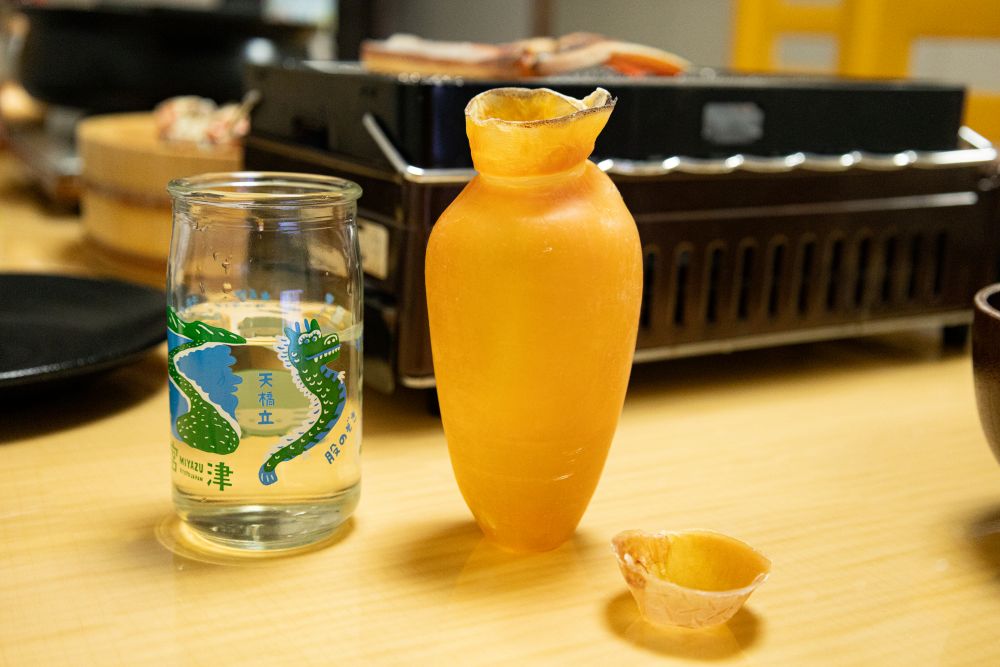
It is dried squid shaped into a sake flask and cup. Fill it with hot sake, drink, then grill the squid afterwards and eat it as a snack.
Pouring the Pin Cup sake into the squid flask and drinking it, the aroma of squid and the sake really do go together — unexpectedly good. One warning: after a few refills the squid softens and starts to slump over.
Grill it afterwards and it makes an outstanding snack. The faint scent of the sake it has absorbed comes through as it toasts.
(Source)
https://www.hakurei.co.jp/2024/08/738/
https://miyazu-city.note.jp/n/n5f2090d99e86
Tango’s Leading Breweries: Hakurei Shuzo, Shirasugi Shuzo and Kinoshita Shuzo
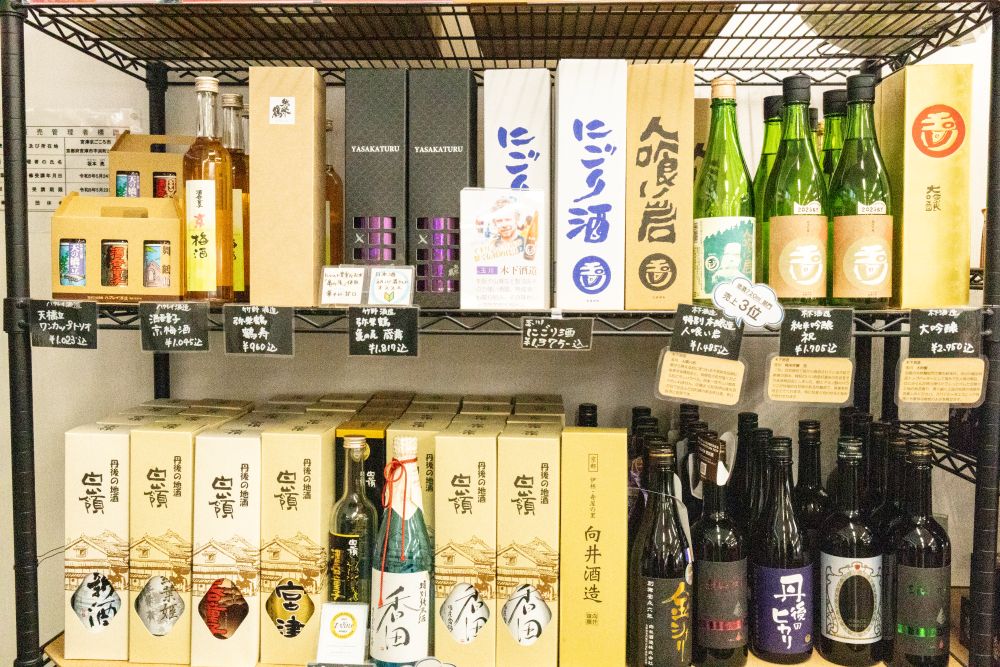
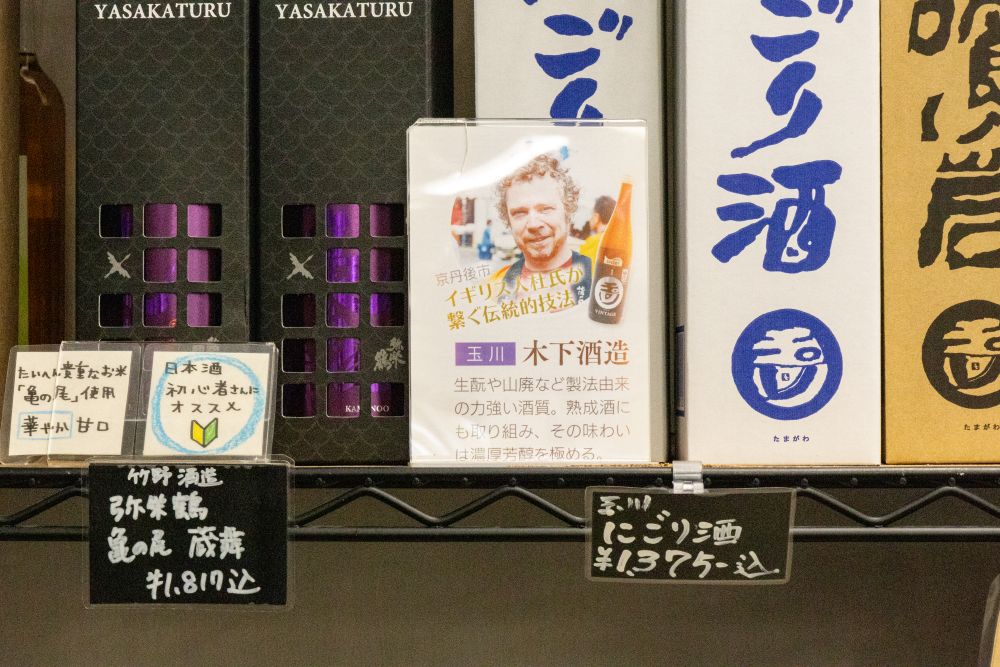
You cannot discuss Miyazu sake without Hakurei Shuzo, the brewery behind Pin Cup.
Their Koden, made entirely from Yamada Nishiki rice grown in Tango and brewed with soft water, is easy to drink and popular with visitors from Japan and abroad alike.
Shirasugi Shuzo is good at sake with a bright acidity that goes down easily.
And Kinoshita Shuzo, whose master brewer is British, combines traditional technique with unorthodox ideas to make sake with a solid, classic weight to it.
There is plenty here that works even if you are not used to sake, so take your time and find one you like.
(Source)
https://www.hakurei.co.jp/products/kouden/
https://www.jizake.com/c/sake/shirasugi/Sake9065-2-720
Rice, Miso and Seasonings from Miyazu’s Mountains and Sea
Miyazu rice and miso have a reputation good enough that people drive in from other prefectures for them.
Tsuyakko Rice
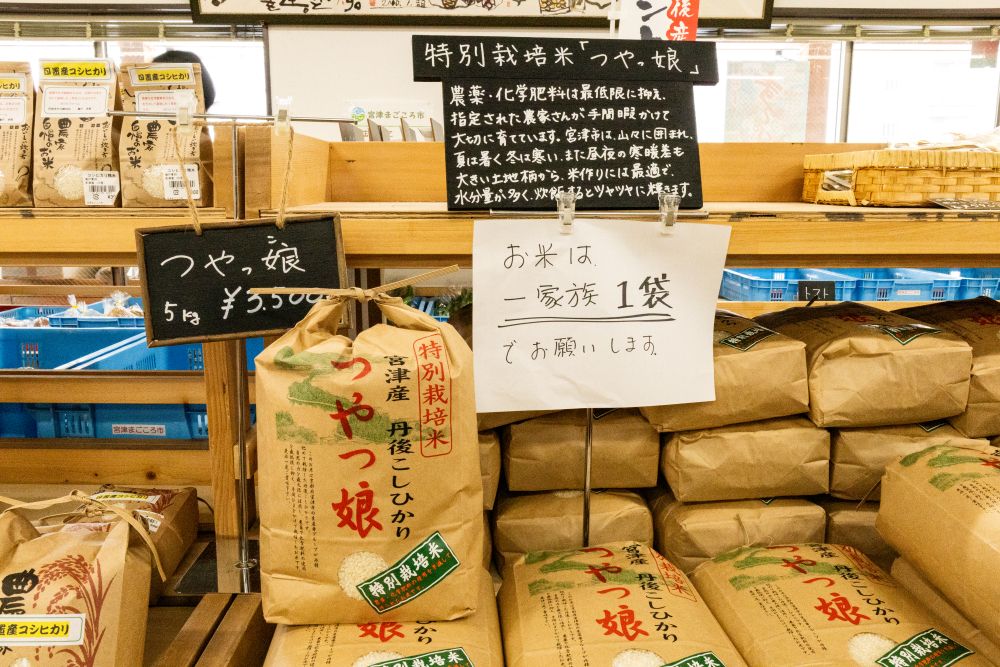
Tsuyakko is Miyazu’s specially cultivated rice.
“Specially cultivated” is a certified standard: pesticide applications and the nitrogen content of chemical fertiliser must both be at least 50% below the norm, and the rice is grown with correspondingly more care.
Tsuyakko is grown using rapeseed oil cake in place of chemical fertiliser. Clean water from the surrounding mountains and a wide temperature swing — between summer and winter, and between day and night — give it a pronounced stickiness and a very good flavour.
It is easy to see why it has a following well beyond the town.
(Source)
https://www.gohansaisai.com/fun/entry/detail.html?i=797
https://www.city.miyazu.kyoto.jp/uploaded/life/8090_17658_misc.pdf
Kanamemaru Salt
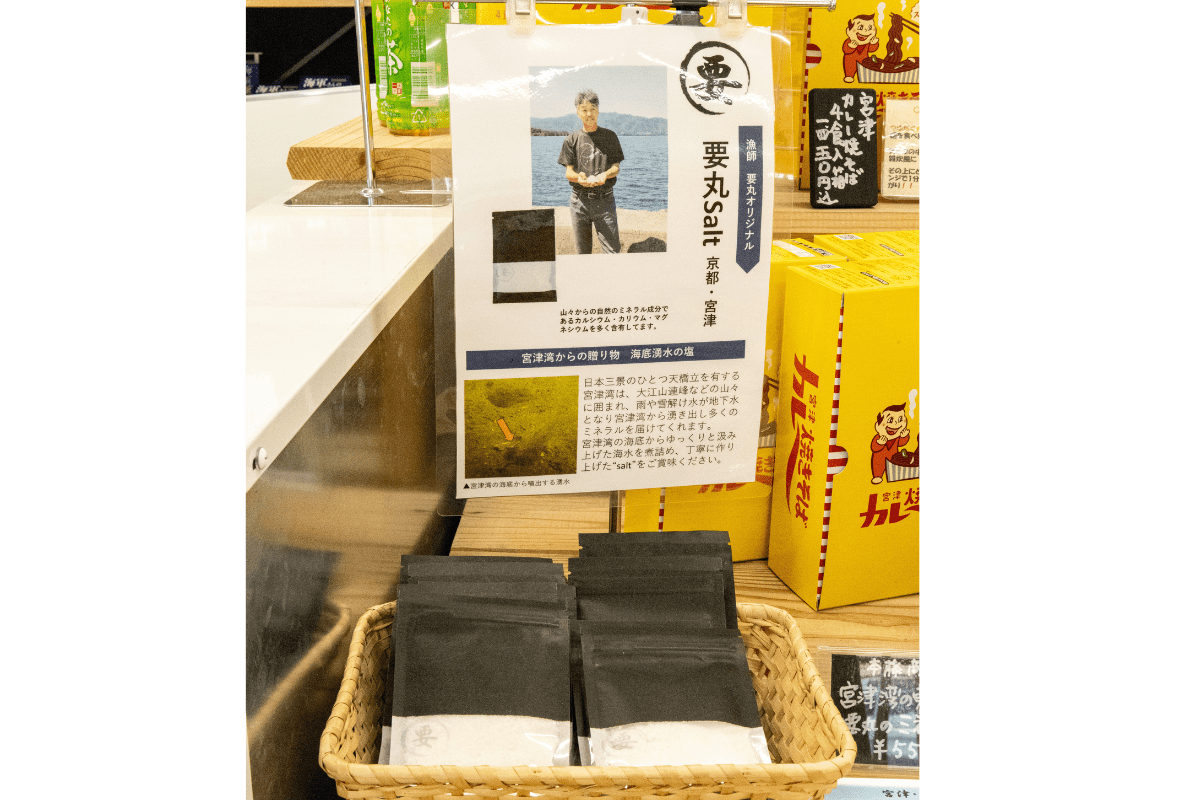
Yasushi Hondo spent years researching Japan’s seas and fish at an aquaculture centre before becoming a fisherman in Miyazu, where he farms cockles and clams.
Kanamemaru Salt came about when Hondo noticed how clean the seabed off Miyazu is.
Working out on the water, he was puzzled that the seabed had no smell of decay. Looking into it, he found spring water rising through it, carrying the nutrient salts that feed the seaweed.
Analysis showed it to be rich in minerals, magnesium and calcium among them.
Kanamemaru Salt now has a reputation among restaurants in and beyond the city for bringing out the flavour of the ingredient, and local households use it too.
Pair it with Tsuyakko rice for a simple salted onigiri, or use it in place of soy sauce on sashimi cut from Miyazu’s fresh catch.
The salt dissolves softly on the tongue and opens into a mellow sea flavour that lifts whatever it is on.
(Source)
https://tangobar.theshop.jp/items/84626139
https://maidonanews.jp/article/15500231
https://thetango.kyoto/food/518/
https://sdgs.yahoo.co.jp/originals/47.html
https://www.leafkyoto.net/spfeature/uminokyoto/
Seya Miso
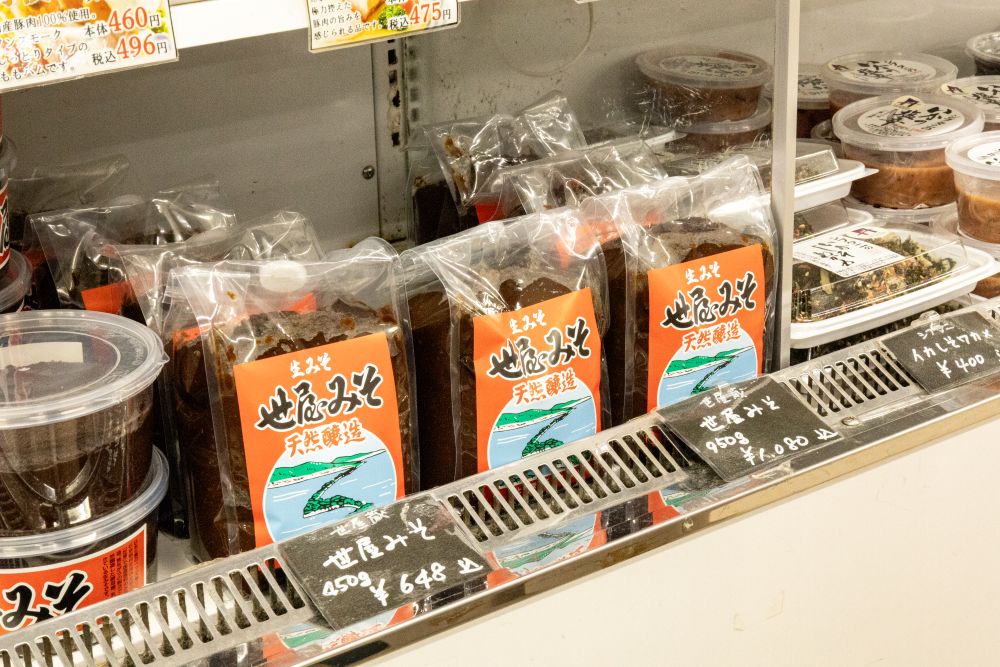
In the Seya area, in the hills of northern Miyazu, a couple have been keeping a miso tradition going since the 1970s.
It is a raw miso, still alive with yeast and lactic acid bacteria, brewed for over a year from carefully chosen ingredients: Nipponbare rice, well suited to making miso koji, pesticide-free soybeans and Japanese salt.
When the Seya miso brewery was looking for a successor, the Shigeta couple decided to take it on. They keep to the traditional method, and have taken on growing the rice and soybeans themselves as well.
You can choose by taste, from firmly salty versions to sweeter miso made with plenty of koji.
Hamakaze Cafe, next door to Miyazu Magokoro Ichi, serves a Seya miso soft-serve ice cream.
The sweet-salty flavour is a little like salted caramel, and it is deservedly popular.
(Source)
https://www.kikkaryo.jp/post/jing-du-fu-gong-jin-shi-shi-wu-zang-nowei-cheng-dukurinoji-cheng
https://seyagura.com/
https://www.instagram.com/hamakazecafe_miyazu/p/CrrtxC_vpXP/
Soft Drinks That Showcase Miyazu Produce
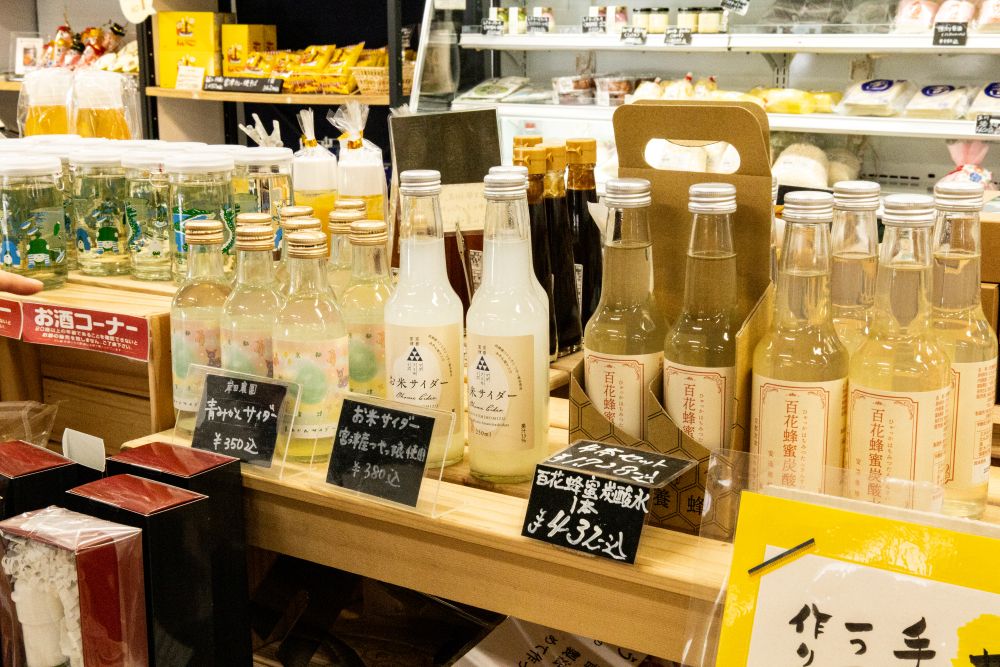
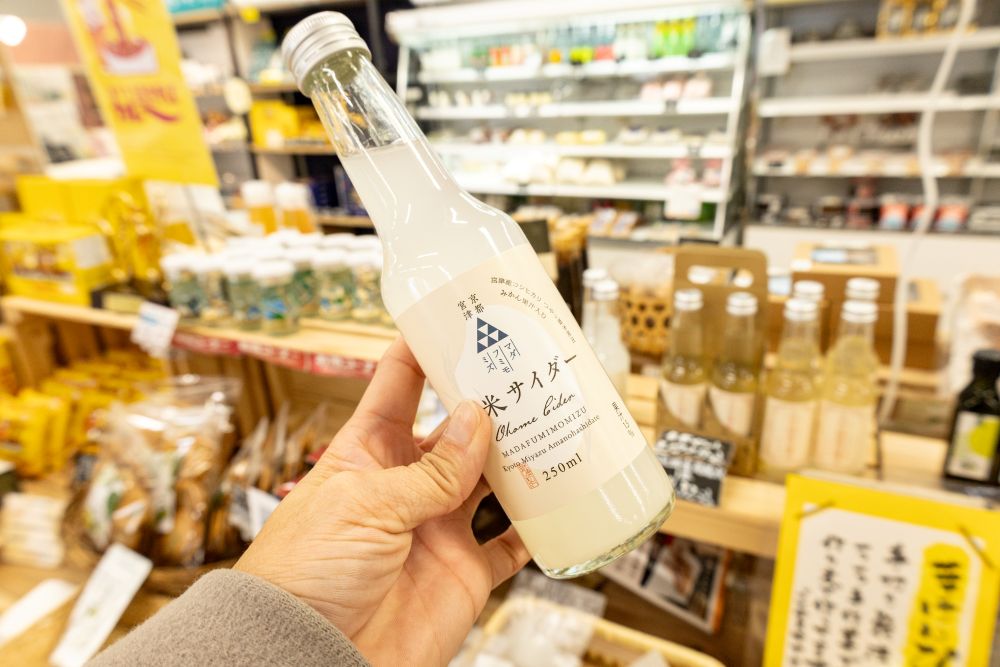
Mada Fumi mo Mizu’s Okome Cider is made with Tsuyakko, the specially cultivated Miyazu rice mentioned above.
It also contains juice from thinned Yura mandarins, giving it a light, fresh aroma over the gentle sweetness of the rice. Very easy to drink.
There are other soft drinks built on Miyazu produce too, such as the Ao-Mikan Cider from Kishida Hide Farm in Tango-Yura.
There Is More: Other Souvenirs Worth Your Attention
Miyazu Magokoro Ichi has plenty of other souvenirs you can only buy here.
Miyazu Curry Yakisoba
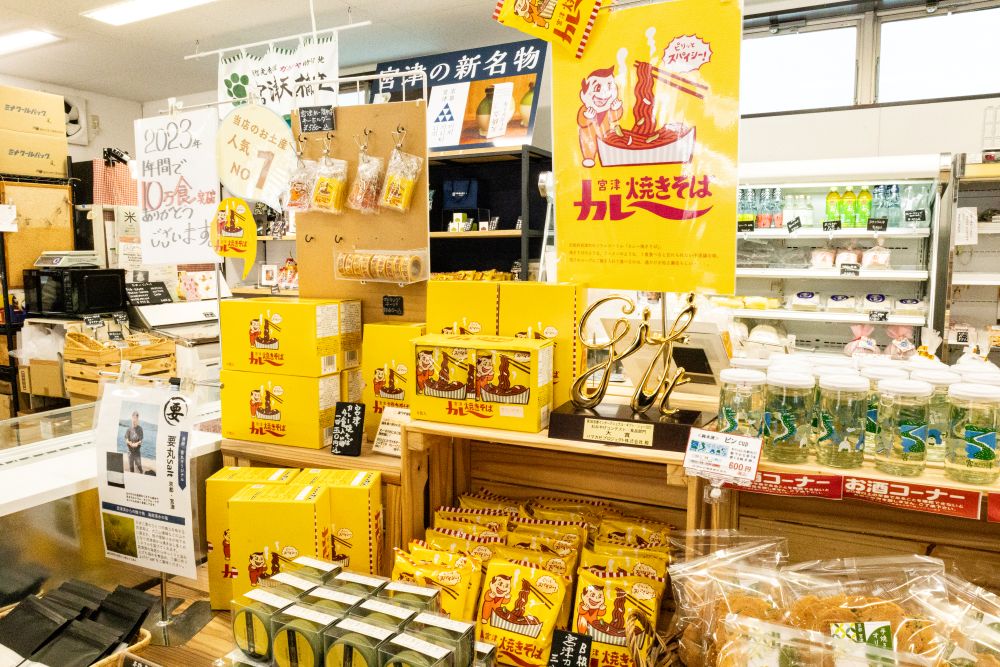
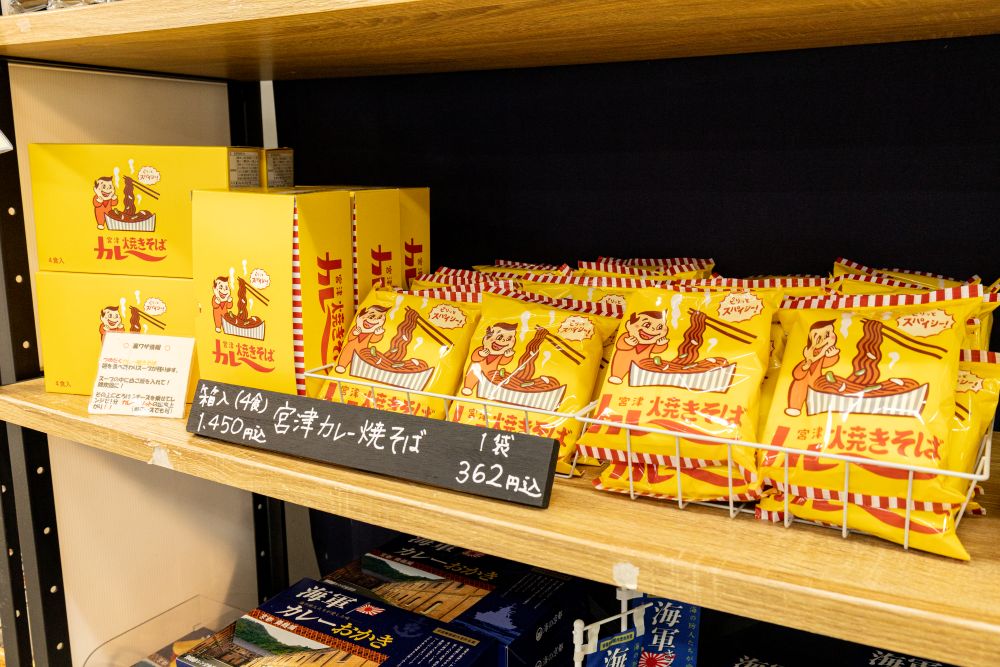
Curry yakisoba is the soul food of Miyazu, loved by everyone in the city.
Curry yakisoba was invented by Mr Wang, a Chinese chef who moved to Miyazu from Taiwan, at his own restaurant Heiwaken.
The distinctive sauce — a Chinese-style broth with Indian curry spices — had the city hooked: you simply have to eat it again.
Heiwaken has since closed and the original is gone, but plenty of Chinese restaurants, teishoku places and izakaya now serve their own versions.
They vary a great deal, from soupy to dry to topped with cheese, so eating your way around them is part of the fun.
Miyazu Magokoro Ichi sells an instant noodle version so you can have it at home. It is an easy way to get that flavour — add whatever you like and make it your own.
The packaging is charming, which makes it a good gift as well.
(Source)
https://miyazu-city.note.jp/n/ne6c11ae6e29a
https://curryyakisoba.com/
https://www.uminokyoto.jp/column/post/63/
Eggs from Ohara Poultry Farm
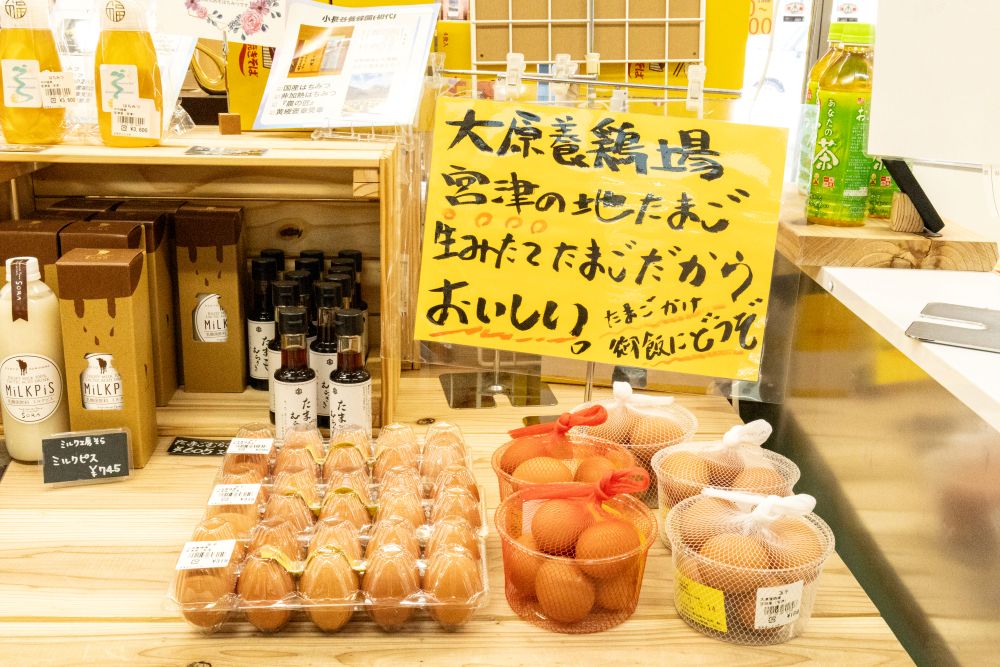
Eggs from Ohara Poultry Farm, a local fixture for many years.
The hens are fed on fish meal and fresh fish trimmings from Miyazu, which gives the eggs a natural sweetness and depth.
Only eggs laid that day go on the shelf at Miyazu Magokoro Ichi; nothing is carried over to the next.
They could hardly be fresher.
Try them with Tsuyakko rice as tamago kake gohan.
(Source)
https://www.kyoto-yokei.jp/member/ohara/
Honey from Chouchou Miel
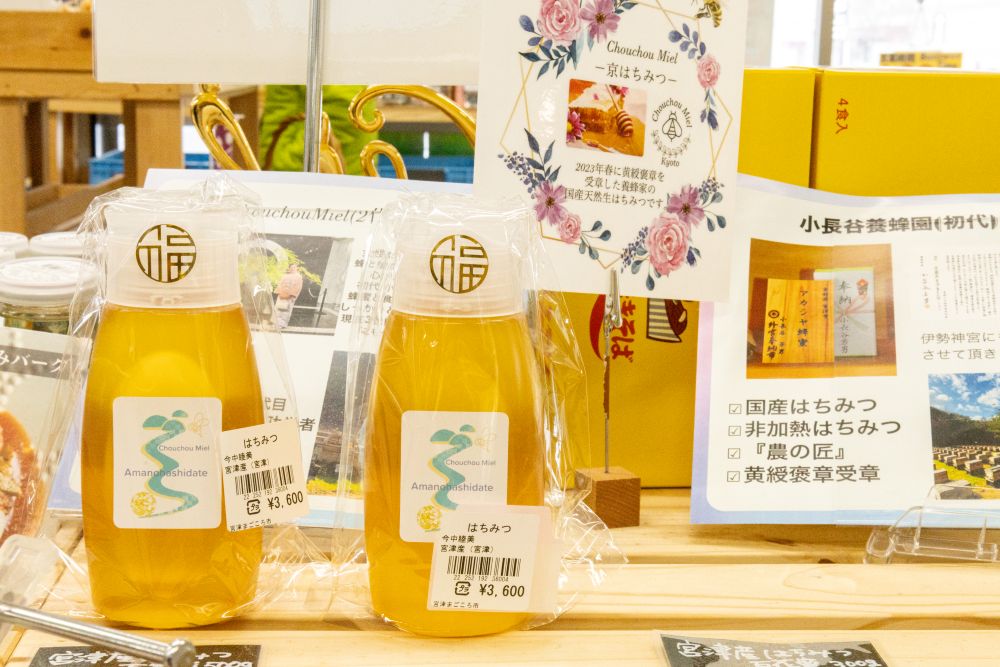
Chouchou Miel took over from Konagaya Apiary, whose acacia honey was once offered at the Outer Shrine of Ise.
Miyazu is also home to Motoise Kono Shrine, known as the original shrine from which Ise Jingu came, so there is a certain connection there.
The acacia honey is carefully made; a single spoonful carries a dense floral aroma and something of the ground it came from.
(Source)
https://www.ise-cci.or.jp/hounouichi/contents/det.php?no=20120528000123
Game Meat and Pet Food from Kamiseya Jyunikuten
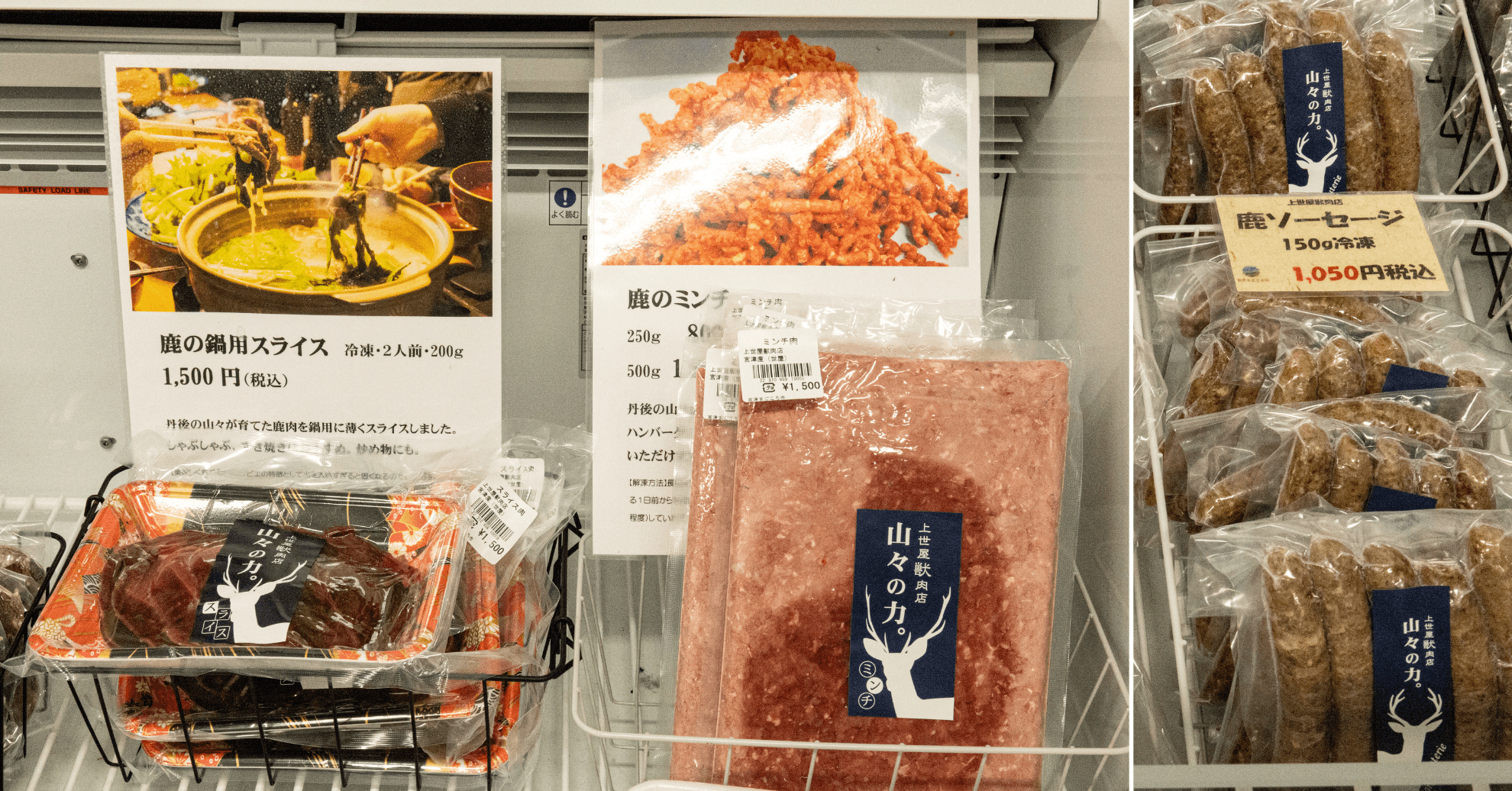
Tango’s rich natural landscape supports a large population of wild deer, and the area is known for good game meat.
The game from Kamiseya Jyunikuten in particular has a good reputation with restaurants both locally and in the cities.
Miyazu Magokoro Ichi carries sliced venison for hotpot — good for shabu-shabu, stir-fries and sukiyaki — minced venison, which is versatile enough for burgers or soboro, and sausages.
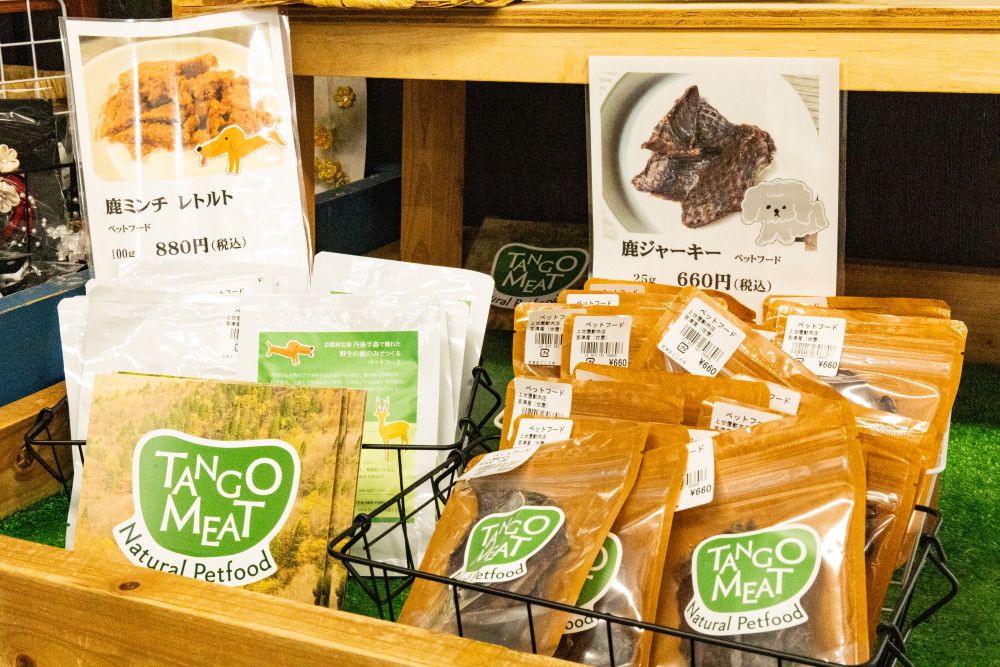
There is pet food as well, including retort-pouch minced venison and venison jerky, so your dog can enjoy Tango game too.
SAPO Soap
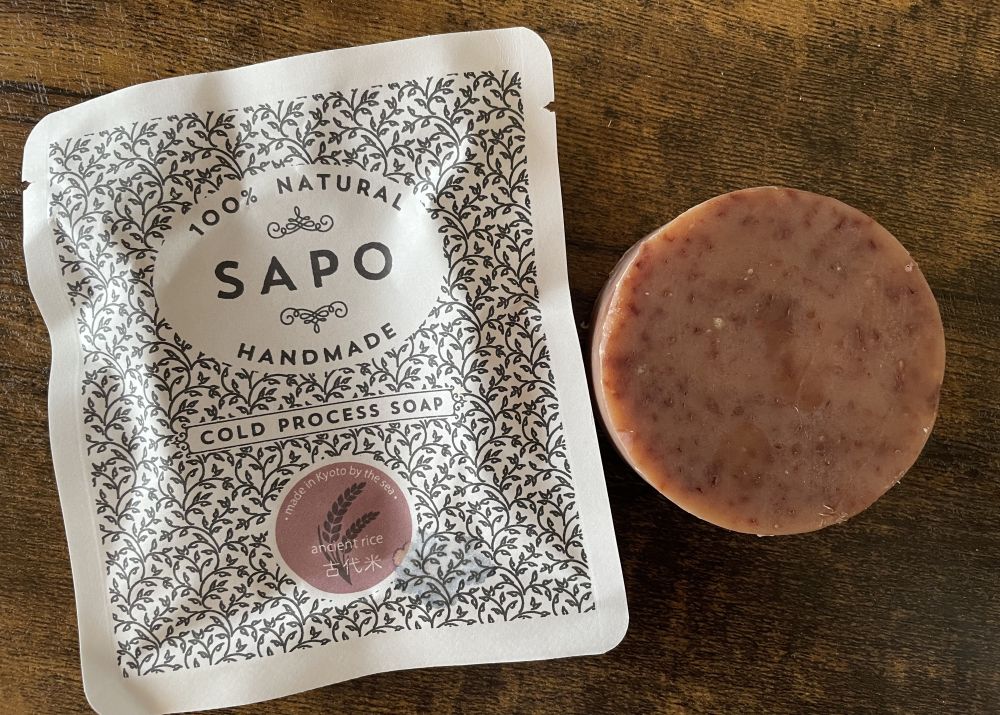
SAPO makes cold-process soap the traditional way, from entirely natural materials.
Cold-process soap is matured slowly without added heat, which leaves a high proportion of natural glycerine and makes for a soap that moisturises well.
The range includes soap made with rice bran and rice flour sourced from pesticide-free rice growers, and soap made with sake lees from the ancient red rice used by Mukai Shuzo in Ine.
The ancient-rice soap is especially good: a gentle scent, a genuinely calming one, and a natural lather that cleans without stripping.
(Source)
https://sapo.handcrafted.jp/items/42836349
https://sapo.handcrafted.jp/items/34541630
[Lunch & Cafe] Osakana Kitchen Miyazu
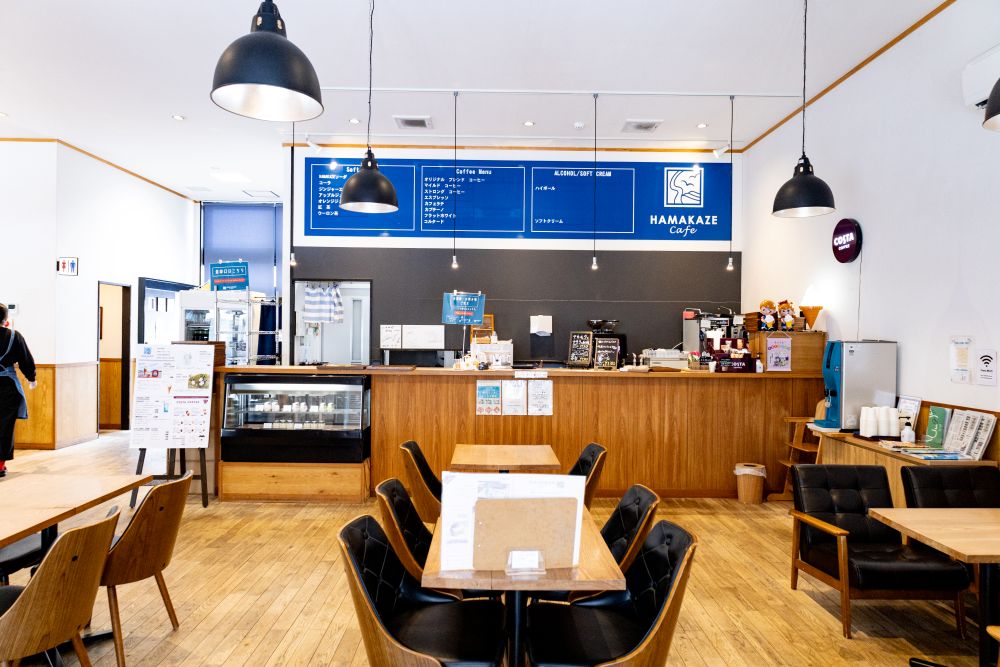
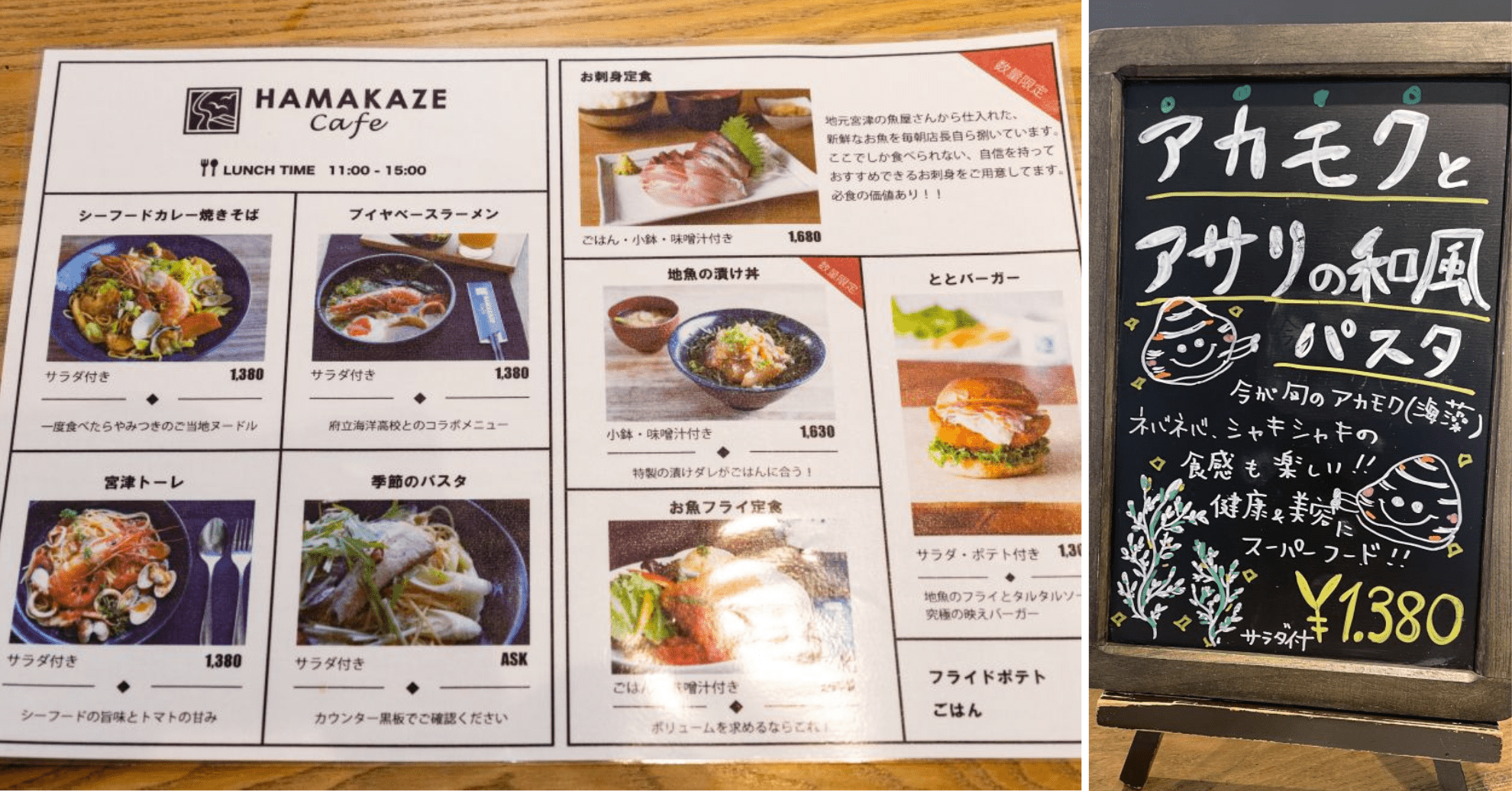
Osakana Kitchen Miyazu builds its menu around fresh Miyazu ingredients, and does it very well.
Lunch runs from sashimi set meals and zuke-don made with the fish in season to a toto burger, bouillabaisse ramen and pasta — Japanese, Western and Chinese all represented.
The seasonal pasta was akamoku and clam pasta, Japanese style (as of February 2025).
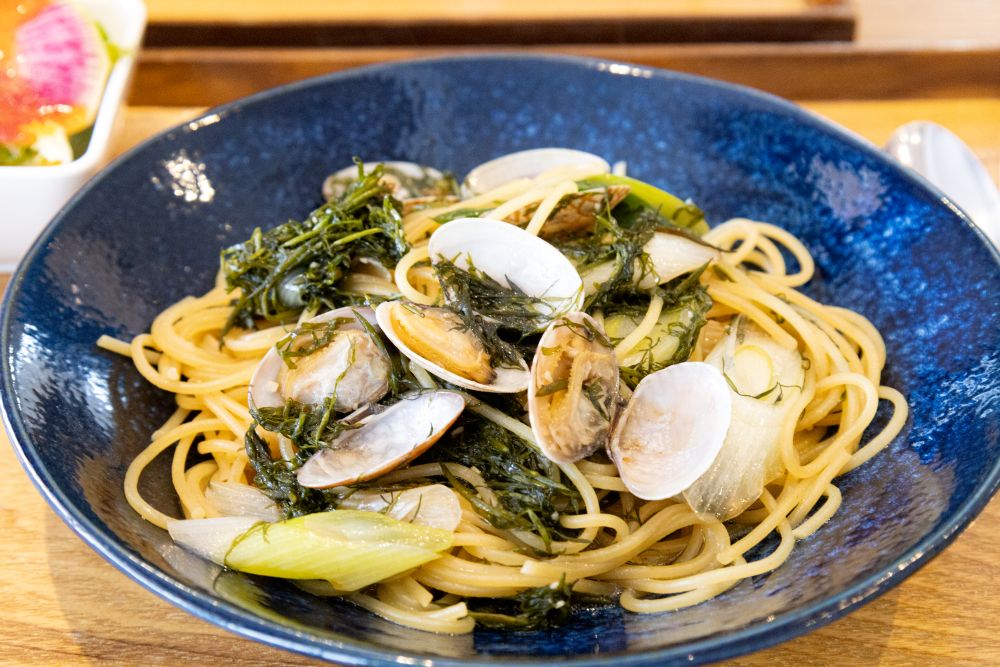
Akamoku has an interesting texture — crisp and slippery at once, a little like chopped wakame — and it works beautifully with a soy-based sauce.
The spring onion was sweet and soft, and the whole thing disappeared faster than expected.
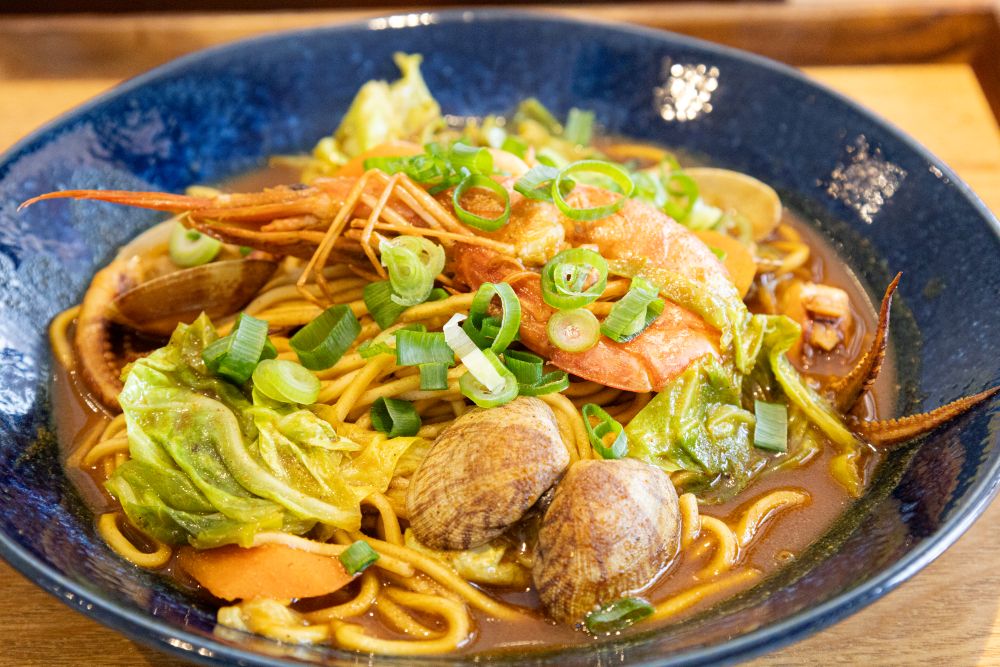
The curry yakisoba here is the soupy kind, loaded with seafood.
A slight lingering heat from the curry spice keeps you going back for more.
It left us wanting to try other versions around town and, at the same time, wondering whether this one was already enough. That is the odd appeal of the dish.
Michi-no-Eki Umi-no-Kyoto Miyazu: Essentials
Michi-no-Eki Umi-no-Kyoto Miyazu is about a 15-minute walk from Miyazu Station on the Kyoto Tango Railway.
Amanohashidate Station is around 10 minutes away by bus or car, so it is easy to stop in before or after seeing the sandbar.
| Michi-no-Eki Umi-no-Kyoto Miyazu Address: 3007 Hamamachi, Miyazu, Kyoto HP:http://michinoeki-miyazu.jp/ Instagram:https://www.instagram.com/michinoeki_uminokyotomiyazu/ |
| Hours | Closed | Contact | |
| Tourist Information Centre | 9:00~17:30 | Open daily | 0772-25-1382 |
| Miyazu Magokoro Ichi | 9:00–17:00 *Closes at 13:00 on 31 December | 1/1~1/3 | 0772-22-6123 |
| Osakana Kitchen Miyazu | 10:00–17:00 Lunch: 11:00–15:00 (last orders 15:00) Evening service: irregular (weekends and busy periods; please enquire) | Wednesdays | 0772-25-1080 |