Kyoto has historic shrines and temples, well-known spots for cherry blossoms and autumn leaves, a wide range of food, and places to try traditional crafts, so there is plenty to come back for.
It also means buses and trains fill up with visitors from Japan and abroad, and getting from place to place can wear you down.
So here is another way to see the city: Kyoto by bicycle, stopping wherever you like.
Central Kyoto has a lot of bicycle parking and rental shops, and the streets are marked for cycling, which makes it well suited to a day on two wheels.
This article covers a suggested cycling route through the city, rental and parking information, practical points to know before you ride, and hotels that rent bicycles.
It should be useful if you want to set your own pace, or if you would rather be moving than sitting on a bus.
Why Kyoto Works for Cycling

Kyoto suits a cycling trip because the streets and parking are set up for it, and because the city is easy to orient yourself in. Here is what that looks like in practice.
Streets and Parking Set Up for Bicycles

Many shrines and temples in Kyoto have bicycle parking, and there is plenty more parking around the city.
There is also a one-day bicycle parking pass, which makes a day of sightseeing cheaper than moving around by bus or train.
City streets are marked with arrow symbols showing where bicycles should ride, so you can see the right line at a glance.
These markings are blue in most of Japan. In Kyoto they are bengara red, an iron-oxide color chosen to fit the streetscape.
It is a small sign of how carefully the city treats its historic views.
A Grid Layout That Keeps You Oriented
Central Kyoto is laid out on a grid, which makes it easy to tell where a sight is in relation to where you are.
Keeping the rough position of the main sights in mind will help you judge direction and distance as you ride.
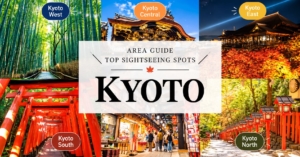
Where the main sights sit, seen from Kyoto Station
East, the Gion area: Kiyomizu-dera, Yasaka Shrine, Nanzen-ji, Heian Jingu and others
West, the Arashiyama area: the Bamboo Grove, Tenryu-ji, Togetsukyo Bridge and others
South: To-ji, Tofuku-ji, Fushimi Inari Taisha, Daigo-ji and others
Center and north: Higashi Hongan-ji, Nishiki Market, Nijo Castle, Kyoto Gyoen and others
For more on where to go in Kyoto, see the articles below.
Small Kyoto Moments Along the Way

Kyoto also has green, open places inside the city itself.
The banks of the Kamo River, for example, are where people who live here walk and cycle.
Riding along the water, with the sound of the current and the leaves, you come to the kawayuka dining decks. They are a summer fixture in Kyoto, so look for them if you are here in the warmer months.

Kyoto Gyoen, Umekoji Park and Omiya Traffic Park also have areas where you can ride. A bicycle covers ground that is hard to take in on foot.
Kyoto Gyoen in particular holds the Kyoto Imperial Palace and the Kyoto State Guest House along with cherry, plum and peach trees, and it shows a side of the city that is easy to miss.
A Suggested Cycling Route in Kyoto

There are places worth riding to in every direction from the center of Kyoto.
The route below runs through the center and north of the city, where the streets and the crafts give a clear sense of how Kyoto works.

Daitoku-ji is the head temple of the Daitoku-ji branch of Rinzai Zen, a school that works toward insight through zazen, seated meditation.
Its grounds hold many sub-temples connected to Oda Nobunaga and Toyotomi Hideyoshi, and it is also the temple where Sen no Rikyu, the founder of the way of tea, was ordered to take his own life.
Daiji-in, one of the sub-temples, runs zazen sessions that are straightforward enough for a first try.
There is a morning zazen session run with the Kyoto City Tourism Association, held in Japanese and English, as well as a longer program that pairs zazen with the way of tea. All of them are by reservation, so check the dates on the official site.
| Daitoku-ji Address: 53 Murasakino Daitokuji-cho, Kita-ku, Kyoto Zazen at the Daiji-in sub-temple: Tel 090-1144-2355 Hours: not published Website: https://www.daijiin.com/ Bicycle parking: free parking on site |

Kamowakeikazuchi Shrine is the oldest shrine in Kyoto. It was separated from the older Kamo shrine, and because it stands upstream on the Kamo River it is known as Kamigamo Shrine, the upper Kamo shrine.
Kamomioya Shrine, which came from the same origin, stands downstream and is known as Shimogamo Shrine, the lower Kamo shrine.
Kamowakeikazuchi Shrine is visited for protection from misfortune and from lightning, for good luck, and for the protection of industry.
The two tatezuna, cones of sand in front of the Hosodono hall, were built up as a place for the deity to appear and have become a symbol of the shrine, so take a moment with them.
| Kamowakeikazuchi Shrine (Kamigamo Shrine) Address: 339 Kamigamo Motoyama, Kita-ku, Kyoto Tel: 075-781-0011 Hours Second torii gate: 5:30–17:00 Romon gate and amulet office: 8:00–16:45 Prayer requests: 9:00–16:00 Website: https://www.kamigamojinja.jp/en/ Bicycle parking: free parking on site |

Yakimochi, a grilled rice cake filled with sweet bean paste, has long been the sweet associated with a visit to Kamowakeikazuchi Shrine.
Two long-standing yakimochi shops stand near the shrine. Jinbado sells them straight off the griddle, and Aoiya Yakimochi Sohonpo wraps a milder bean paste in a thinner cake.

Shake were the houses of the priests who served the shrine generation after generation. In the Edo period they were built along the Myojin River on the shrine grounds, and the area grew into a settlement of priests and farmers.
The houses were kept low so that none would stand higher than the torii gate of the shrine.
The lane where they stand, with the Myojin River running beside it, is one of the best stretches of the ride.

Past Shake-machi, the route follows the Kamo River south at an easy pace toward Kamomioya Shrine.
Kamomioya Shrine sits inside Tadasu no Mori, a stand of old forest that carries its own set of legends.
The sazare-ishi stone at the entrance is said to house a spirit, and it appears in the words of the Japanese national anthem. Like Kamowakeikazuchi Shrine, this is a shrine with national standing.
| Kamomioya Shrine (Shimogamo Shrine) Address: 59 Shimogamo Izumikawa-cho, Sakyo-ku, Kyoto Tel: 075-781-0010 Hours: inside the Romon gate 6:30–17:00 (Kawai Shrine 6:30–16:30) Times may change when ceremonies are held Website: https://www.shimogamo-jinja.or.jp/english |

Nishijin-ori is the woven silk that has decorated kimono in Kyoto for centuries.
At the Nishijin Textile Center you can watch skilled weavers at work on an obi sash, and try hand-weaving a small table runner on a compact loom.
There is also a kaleidoscope workshop, where you line the tube with Nishijin fabric and choose the beads inside.
Both work well as something to make with children.
The center also sells ties, bags and Kyoto-only straps made from Nishijin-ori, which make good gifts to take home. Admission to the building itself is free.
Hand-weaving workshop
Time: about 40 minutes
Ages: fifth grade and above
Price
Adults: 2,750 yen (2,530 yen for groups of 15 or more)
Students: 2,530 yen (2,200 yen for groups of 15 or more)
Reservation required
Kaleidoscope workshop
Time: about 30 minutes
Sessions: 10:30, 13:30 and 14:30
Ages: children in second grade and below take part with a guardian
Price: 1,980 yen
Reservation required
| Nishijin Textile Center Address: Horikawa-dori Imadegawa-sagaru, west side, Kamigyo-ku, Kyoto Tel: 075-451-9231 Hours: 10:00–16:00 (October to March) / 10:00–17:00 (April to September) Admission: free Closed: Mondays and over the New Year period (When Monday is a public holiday the center opens and closes the following Tuesday) Website: https://nishijin.or.jp/eng/ |
Of the streets on this route, Imadegawa-dori is the one lined with bakeries.
These are the shops people in Kyoto use day to day. They are worth a stop for breakfast or a break mid-ride.
Bakeries on Imadegawa-dori

Pin de Bleu Horikawa-Imadegawa
A bakery built on the idea of walking in with the same excitement as a child heading to a sweet shop with coins in hand, selling good bread at prices anyone can pay.
Alongside the staples people reach for without thinking, shokupan, cream buns, anpan, curry buns and coarse-ground sausage rolls, there are seasonal breads. The cream bun is the one worth queueing for.

Le Petit Mec Imadegawa
A Kyoto bakery that French bakers and chefs have called the most French bread in Japan.
Take a seat at one of the red checked tables and eat in.
The tart set, a tart of your choice with coffee or tea, is a good way to put something back in the tank.

Boulange Okuda Nishijin
A bakery that takes its time over bread you can eat at breakfast, at lunch or with a drink in the evening.
The range runs from soft breads to hard crusts and filled savory buns, and the shokupan, cream buns and bacon epi are the ones to start with.
The dough has more chew since the shop was updated, and it is the kind of bread you could eat every day.

Marry France Imadegawa
An anpan shop that has been part of the Imadegawa neighborhood for many years.
Inside the shop dough is a thick layer of chunky red bean paste, simmered fresh every day.
The ogura anpan, yomogi anpan and yakimochi-style anpan are all worth taking one of each.
Croissants, curry buns and cream buns are on the shelves too.
Rental Shops, Parking Maps and the Day Pass
Next are the rental shops, the parking and the day pass that make cycling in Kyoto easier.
Where to Rent a Bicycle

Look for rental shops with this certification mark
For a rental, it is worth using a shop certified by the City of Kyoto.
Certified shops carry bicycle liability insurance and can serve customers in English, so you have somewhere to turn if something goes wrong.
Use the map of certified rental shops below and pick one that fits where you start, where you finish and how long you want the bicycle.
Map of rental shops certified by the City of Kyoto