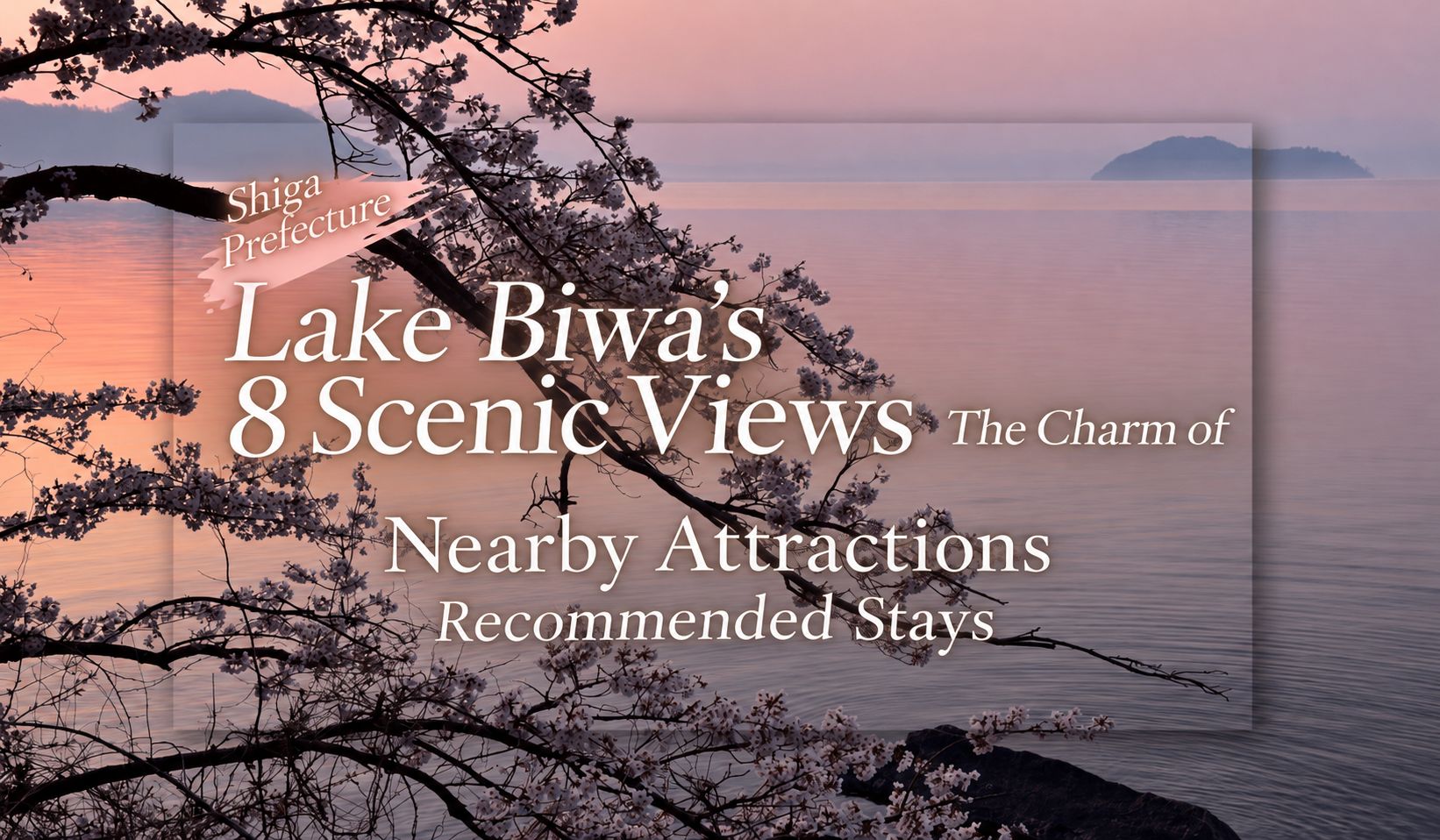
Lake Biwa (Biwako) in Shiga Prefecture is the largest lake in Japan.
The area offers lake activities, cycling, and skiing, making it an appealing destination in every season.
It also has many scenic spots, such as Metasequoia Avenue, Shirahige Shrine, and Biwako Valley, and the Eight Views of Lake Biwa are especially worth seeing.
This guide introduces the appeal of each of the Eight Views in turn.
It also covers their historical background, nearby sights, and places to stay, and may be of interest to those who enjoy Japanese history, traditions, and natural scenery.
What Are the Eight Views of Lake Biwa?

The Eight Views of Lake Biwa are eight scenic areas around the lake, chosen in a public contest among Shiga residents. They were selected after Lake Biwa and its surroundings became Japan’s first quasi-national park in 1950.
The concept of “eight views” began in China as a way of appreciating scenery, with each view described by combining a place name with something seen there.
In Japan, the idea spread through works such as the Eight Views of Omi, famously depicted by the ukiyo-e artist Utagawa Hiroshige, and many other sets of “eight views” followed.
Each of the Eight Views of Lake Biwa has its own historical background, and they reflect the traditions and reverence for nature that people have preserved over time.
Visiting them one by one is a good way to experience the traditions of each area.
Morning Mist: The Rocky Shore of Kaizu-Osaki


Morning Mist: The Rocky Shore of Kaizu-Osaki is located at Kaizu-Osaki in Takashima City, on the north side of Lake Biwa.
Rugged cliffs drop toward the lake, and when mist rises from the water in the morning, the area takes on a dreamlike atmosphere.
Together with the blue water and Chikubu Island in the distance, the view feels even more majestic.
In spring, about 800 cherry trees bloom along the lake for about 4 km at Kaizu-Osaki, making it a popular route for driving and cycling. A walking path from the Kaizu-Higashiguchi area also makes it pleasant to explore on foot.
The area once prospered as a post town and port for lake transport, and the stone walls built to protect houses from waves and wind look almost like castle ramparts.
They give a sense of what the town was like in its heyday.
What Is a Post Town?
A post town was a place in the Edo period that combined lodging, freight services, and rest stops.
Feudal lords and samurai used them for overnight stays and shipping goods on their way to Edo. They also served as rest stops for ordinary travelers, making them lively relay points.
Nearby Sights


Nearby Places to Stay


Cool Breeze: The White Shore of Omatsu-zaki


Cool Breeze: The White Shore of Omatsu-zaki is located in Minamikomatsu, Otsu City, on the southern part of Lake Biwa.
Pine trees line a half-moon-shaped sand spit, formed by sand carried on the water, that extends into the lake. The scene of waves washing onto the white sand is known as hakusa seisho (white sand and green pines)*.
The character for “tei” in the name of this view means a shore or water’s edge, and the name “hakutei” suggests waves washing onto a shore and looking white.
Many of the roughly 1,500 to 1,600 pine trees are more than 100 years old, showing how long this scenery has been valued.
Omatsu-zaki is now known as Omi-Maiko, also the name of a station on the JR Kosei Line, and its address is Minamikomatsu, Otsu City. One theory holds that “Komatsu” comes from “Omatsu.”
The clear blue water makes this area popular in summer for swimming and lake activities.
The nearby Omi-Maiko Inner Lake, which reflects the Hira Mountains like a mirror, is also worth a visit.
Nearby Sights


Nearby Places to Stay

Misty Rain: The Forests of Mt. Hiei


Enu means a misty rain that falls like smoke. Fine rain falling over tall, straight forests creates a serene and deeply spiritual atmosphere.
This misty rain is said to be especially common in spring, and the scene resembles an ink painting.
You can see it on Mt. Hiei, home to Enryaku-ji Temple, the head temple of the Tendai school founded by Saicho.
Japanese Buddhism has various schools, including Jodo, Jodo Shinshu, and Rinzai, and their founders Honen, Shinran, and Eisai all studied on Mt. Hiei.
For this reason, Mt. Hiei is known as the mother mountain of Japanese Buddhism.
Enryaku-ji is not a single building but the collective name for more than 100 buildings spread across about 1,700 hectares of Mt. Hiei. The views from its lookout points are also beautiful, so allow plenty of time.
A short distance from Enryaku-ji is Ogoto Onsen, a well-known hot spring area in Shiga.
Nearby Sights


Nearby Places to Stay

Sunset: The Clear Stream of Seta and Ishiyama


Seta no Karahashi Bridge, which spans the Seta River, is one of Japan’s three oldest bridges. It appears in the Nihon Shoki, one of Japan’s oldest historical records, and was long an important military and transportation point on the way to Kyoto.
It is also said to be the origin of the proverb isogaba maware (“more haste, less speed”). The bridge was rebuilt in 1979, but its gently arched form and decorated railings retain the look of earlier times.
The reflection of the setting sun and the bridge on the river is especially beautiful.
Japanese Words for Sunset
Japanese has several words for sunset, and one theory distinguishes among them as follows.
・Yuhi (夕日): The setting sun itself
・Yuhi (夕陽): The light of the setting sun or the sky colored by it
・Shayo (斜陽): A literary expression for the setting sun, also used to describe a declining industry
The Eight Views name for this scene uses the character for the second word, which suits the light of the setting sun reflected on the Seta River.
Near the bridge is Ishiyama-dera Temple, a historic Shingon temple where Kannon is worshipped and associated with safe childbirth and matchmaking.
Seta River and Lake Biwa River Cruise
A cruise operates on the retro-style paddle steamer Ichibanmaru, offering a different view of the bridge from the Seta River.
It departs from and returns to Ishiyama-dera Port, making it convenient before or after a visit to Ishiyama-dera Temple.
*Operating days vary by season. Inquiries: Lake West Yacht Club, 077-572-2114.
Nearby Sights


Fresh Snow: The Grand View from Mt. Shizugatake


Mt. Shizugatake, 421 meters high in northern Shiga, offers views of Lake Yogo to the north, Mt. Ibuki to the east, and Lake Biwa and Chikubu Island to the south. The view of snow-covered Mt. Ibuki in winter is especially impressive.
Mt. Shizugatake is known for the Battle of Shizugatake, fought in 1583 between Toyotomi Hideyoshi and Shibata Katsuie for power after the death of Oda Nobunaga. Battlefield monuments and graves remain at the summit.
Its steep slopes and deeply curved inlets add to the solemn atmosphere of this historic site.
From spring to fall, the summit can be reached by trail or lift, and hiking courses connect historic sites. In winter, snowshoe trekking may also be available.
The climb is a good opportunity to reflect on the area’s history.
Nearby Sights


Deep Green: The Reflection of Chikubu Island


Chikubu Island is home to Hogon-ji Temple, one of Japan’s three great Benzaiten sites among the more than 1,000 dedicated to Benten, a guardian deity in Buddhism, along with Enoshima Shrine in Kanagawa and Itsukushima Shrine in Hiroshima.
Hogon-ji Temple and Tsukubusuma Shrine were once a single institution known as Chikubushima Shrine, and Hogon-ji was separated in the Meiji era. Today, Chikubushima Shrine is also known as Tsukubusuma Shrine and is revered as a site of Benzaiten worship.
Historic temples and shrines stand on this conifer-covered island, and its beauty against the blue water led to its selection as one of the Eight Views.
You can reach it by cruise boat from Imazu Port or Nagahama Port and visit Hogon-ji Temple and Tsukubusuma Shrine.
Nearby Sights


Nearby Places to Stay
Bright Moon: The Old Castle of Hikone


Hikone Castle stands in eastern Shiga Prefecture.
It was built over about 20 years on the orders of Tokugawa Ieyasu, the first shogun of the Edo period, and is one of only five castles in Japan whose main keeps are National Treasures.
Built more than 400 years ago, Hikone Castle had strong military functions and also served as a symbol of power.
Its stone steps and the interior of the keep have been carefully preserved.
These preserved features show how carefully the castle was designed for defense.
Learning about its history makes a visit more rewarding.
Under the moonlight at night, the castle has a majestic beauty that conveys the weight of its history.
Hikone Castle sometimes has special night openings in spring and fall, when you can see it illuminated.
Nearby Sights


Nearby Places to Stay

Spring Colors: The Waterways of Azuchi and Omihachiman


Omihachiman City is located in southeastern Shiga Prefecture.
It is home to the Azuchi Castle Ruins, built by Oda Nobunaga, and its finely crafted townhouses and Omi merchant residences recall its days as a prosperous castle town.
The waterways of Omihachiman, a component cultural property* of Japan Heritage, are part of the traditional landscape carefully protected by local residents.
What Is Japan Heritage?
Japan Heritage refers to areas and sites recognized by the Agency for Cultural Affairs to protect the historical appeal and character of a region and pass it on to future generations.
A component cultural property is one essential to conveying the traditions and culture of the area.
“Lake Biwa and Its Waterside Landscapes: Water Heritage of Prayer and Daily Life” is recognized as Japan Heritage, and the waterways of Azuchi and Omihachiman are one of its components.
The waterways of Omihachiman are lined with reed beds, creating a rich natural landscape.
Traditional hand-rowed boats tour the waterways, letting you move slowly along the water while listening to the birds and watching the reeds.
In spring, you can drift slowly under the cherry blossoms, making it especially suitable for those who want to view cherry blossoms away from the crowds.
Hand-rowed boats include six-person and eight-person options, and a private charter is another option for groups.
The boats operate in the area around JR Omi-Hachiman Station. Fees and times vary, so choose one that suits your plans.
Boat Tours on the Waterways
| Time required | Fee | Reservations | |
| Suigo no Sato Maruyama | 60 minutes | Adults 2,200 yen Students 1,870 yen Elementary school students 1,100 yen | Book online |
| Hachimanbori Meguri, Shinmachihama | 30 to 40 minutes | Adults 1,300 yen Children 750 yen | Book online |
| Hachiman Moat Tour, Waden | 35 minutes | Adults 1,500 yen Children 1,000 yen | Book online |
Nearby Sights


Nearby Places to Stay

Summary
This guide introduced the Eight Views of Lake Biwa.
Each view reflects its own history and traditions, offering a chance to learn about the culture of the area.
Use this guide when planning your trip to Lake Biwa.
The following article introduces recommended places to stay with convenient access to the Eight Views.
It includes places to stay with hot springs, local food, and strong reviews.