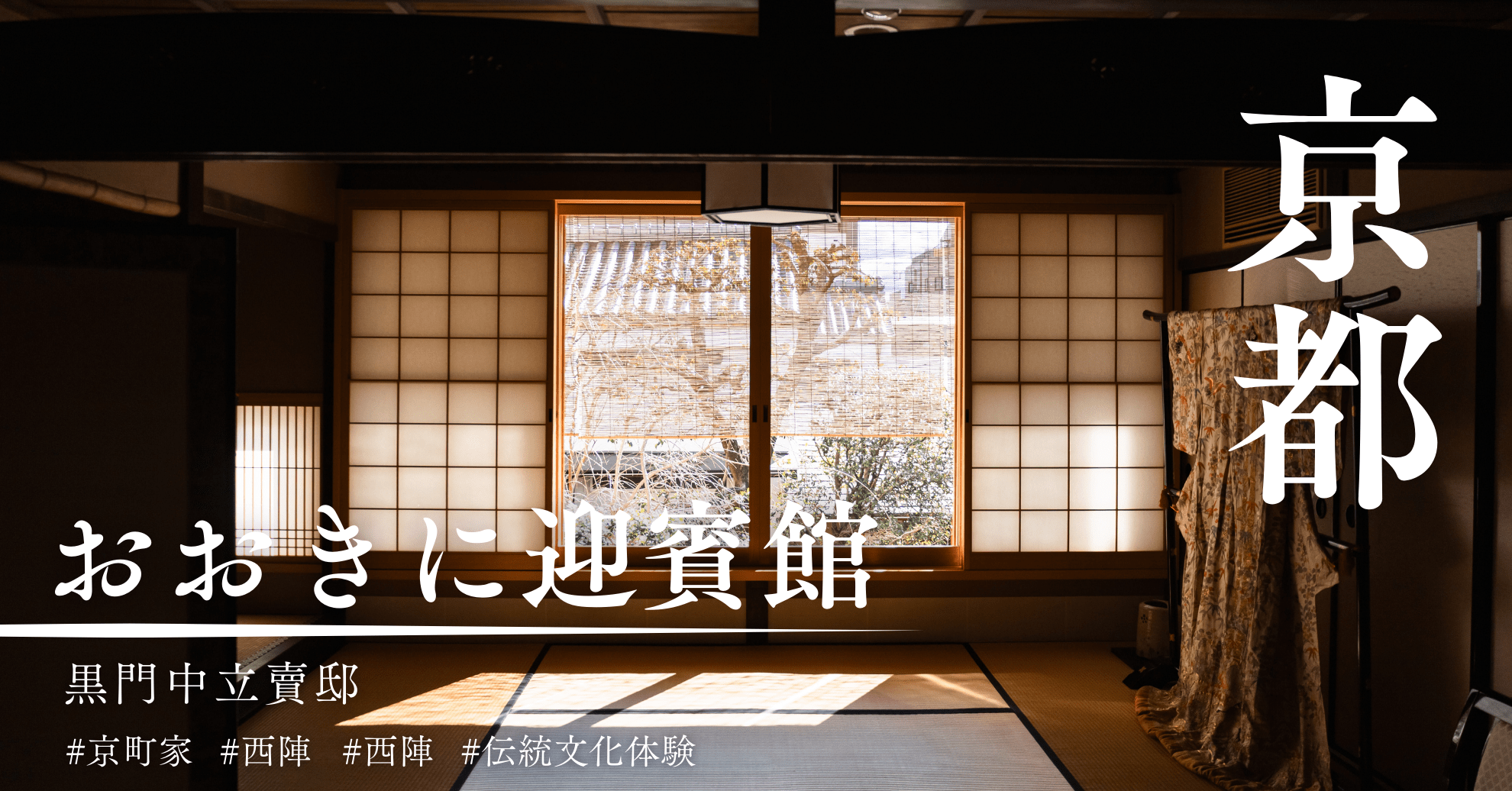
Machiya have been part of Kyoto for generations.
The word covers a range of buildings, from merchants’ houses that changed use over the years to Western-style ones built in a mixed Japanese and Western manner.
This article covers the Kuromon Nakadachiuri-tei of Ookini Geihinkan, one of the best-known machiya in Kyoto, along with the architecture and culture that have been kept up in it.
It also covers Fukuyoshi, the restaurant on the same grounds, for anyone who wants sushi and Japanese food in an old machiya.
What Ookini Geihinkan Is: Kuromon Nakadachiuri-tei and Shimei Izumoji-tei


Source: https://geihinkan.ookini.jp/
A little under ten minutes by car from Kyoto Gyoen, on Kuromon-dori, stands the Kuromon Nakadachiuri-tei of Ookini Geihinkan.
It began as a thread merchant (fitting for the Nishijin weaving district) and has since served as a restaurant and a clinic, among other things. Fukuyoshi, on the grounds, serves sushi and small dishes made with fresh seafood.
Ookini Geihinkan has a second machiya, the Shimei Izumoji-tei.
The Shimei Izumoji-tei stands near the Kamo River and was the house of an essayist. An old sukiya-style machiya with a Western wing added, it is Japanese and Western together. It also has a sushi restaurant, Sushi Kondo, run by a chef with more than twenty years at the counter.
Both are used for cultural experiences, concerts, events and exhibitions, for meals, and as accommodation.
Plum Blossom and Nadeushi in the Shoin


Here is what we found on a visit to the Kuromon Nakadachiuri-tei.
The ground floor holds Fukuyoshi along with guest rooms that look onto the garden. The beams and the walls keep traces of how people lived here.
The shoin is one example.
A shoin is a room that was once a study, set off by a tokonoma alcove and shoji screens.


As a reminder of that use, an inkstone box sits where the desk would have been. Paper and brushes were kept inside.
The box is painted with plum blossom.
Late February, when we visited, is when the plums begin to open at nearby Kitano Tenmangu and the Baien plum garden opens to visitors.
In the tokonoma of the shoin stood a row of nadeushi, a parent and its calves.
A nadeushi is an ox figure that people at Kitano Tenmangu have long stroked.
Sugawara no Michizane, the deity of the shrine, was born in the year of the ox and regarded oxen as messengers of the gods, so nadeushi sit all over the grounds: along the approach, at the gate and by the water basin.
February 5 is also the anniversary of Michizane’s death, which explains the plums and the nadeushi in the shoin.
This time the nadeushi were arranged in a circle; sometimes they stand in a straight line.

Look up and there is a bag with long cords hanging above the tokonoma. This is a kariroku, a charm filled with incense and kashi fruit.
In India the kashi fruit was long used as medicine, and blended with other herbs it was thought to keep misfortune away. The custom is thought to have reached Japan along with Buddhism.
The room also holds an image of Sugawara no Michizane and a charo, the brazier used when whisking matcha.


The Okudosan in the Kitchen Behind Fukuyoshi


In the kitchen that serves Fukuyoshi stand the okudosan.
Okudosan is the Kyoto word for a traditional kamado stove. It comes from hidokoro, a place for fire, and kundo, the passage for smoke, worn down over time to kudo.
The “o” and “san” come from the Kyoto habit of speaking of things with a little affection, as in O-Inari-san or O-Higashi-san.
Rice was once cooked over the fire in a kama, and Fukuyoshi still cooks the rice for its sushi on these okudosan.
Rice cooked over a kamado comes out plump, with its sweetness and scent brought forward, which suits fresh fish.
Study: Why Kyoto Machiya Are Called Eel Beds

You may have heard Kyoto machiya described as an eel’s bed.
In Edo-period Kyoto, tax was levied according to the width of the frontage, that is the width of the entrance, so houses were built narrow at the front and deep behind.
The long, narrow layout resembled the narrow space an eel sleeps in, hence the name.
Seen that way, a wide entrance marks a wealthy household. It is worth comparing frontages as you walk among the machiya.
A Setsubun Scroll Marks the Season

On the way to the stairs we found a hanging scroll of an oni in tears, with soybeans set in front of it.
February is the season of Setsubun, and the scroll shows an oni crying because the holly at the door keeps it out.
Should an oni get in anyway, the soybeans in front would see it off.
The painting is by Matsumura Goshun, a painter of the late Edo period. The calm, refined brushwork almost makes you feel sorry for the oni.
Why do oni dislike holly and soybeans?
Oni are said to dislike holly because of how it looks: they fear the sharp thorns will prick their eyes.
Soybeans are said to hold a spirit, which makes them well suited to driving oni out. Besides holly and soybeans, customs vary by region: some households display hiiragi-iwashi, a holly sprig stuck through a strong-smelling sardine head, and some throw peanuts instead of soybeans.
Comparing the Setsubun customs of different regions is a pleasure in itself.
Fusuma That Tie People Together


Upstairs are guest rooms with finely embroidered kimono and folding screens on display. The light through the shoji is part of the appeal.
In the large room, lit fusuma screens set the tone. Look closely at the pattern and you will find circles hidden in it.
They are the work of washi designer Eriko Horiki, who set them there as a wish for en, the circle that also means a connection between people. With the soft light, it is a warm thing to sit with.
Rooms Full of the Craftsmen’s Humor


In the bedroom beyond, a small window is set into a white wall.
Open it and you find it packed with straw. The wall is filled with straw for insulation, warmth and humidity control.
This is straw bale construction, in which straw is set into an earthen wall to insulate, keep out the cold and absorb moisture.
The technique came from the United States and now draws attention for its low environmental load and its energy saving.
Besides the earthen walls and the straw, the rooms use natural materials such as wood and tatami that work as natural air cleaners. There is something to learn from building with what nature provides.
The small window in the wall, by the way, was the craftsman’s idea of fun.
Picturing him imagining how surprised people would be to find it packed with straw is a pleasure in itself.
There is more of that craftsmanship and humor throughout the house. You do not need to know architecture to enjoy it.
Fukuyoshi


In a room where the atmosphere of Kyoto meets modern art, sushi and small dishes are made with seafood chosen by a first-rate chef.
Fukuyoshi serves a sushi course and an omakase course that adds small dishes.
There is an open counter where you can watch the chef work, and private rooms that look onto the old garden.
Check: What Are the Name Cards on the Wall?

The walls carry the hanameishi of maiko and geiko: round ones and long ones, some in sweet lettering, some plain and grown-up.
Maiko and geiko sometimes bring guests to Fukuyoshi, and sometimes come privately.
Besides hanameishi, they may also carry uchiwa fans as calling cards. Leaving a card at a shop they like is a pleasant custom.
After a Visit to the Kuromon Nakadachiuri-tei

This article has covered a visit to the Kuromon Nakadachiuri-tei, the merchant’s house of Ookini Geihinkan.
Look closely and the ornaments and displays set casually around the house each carry an intention, which is the Kyoto idea of hospitality.
The plum and Setsubun displays are seasonal, and the house changes them month by month. March brings Hinamatsuri and the cherry blossom.
What stayed with us was how much the craftsmen seem to have enjoyed the building.
Cultural experiences and events are held here regularly.
At the Machiya Day event you can try tea ceremony or traditional crafts indoors.
Ookini Geihinkan: The Basics
Kuromon Nakadachiuri-tei and Fukuyoshi
| Ookini Geihinkan Kuromon Nakadachiuri-tei Address: Yakunin-cho, Nakadachiuri-dori Kuromon Higashi-iru, Kamigyo-ku, Kyoto TEL:075-451-0092 HP:https://geihinkan.ookini.jp/ Instagram:https://www.instagram.com/ookinigeihinkan/ Booking: https://travel.rakuten.co.jp/HOTEL/180397/180397.html Please enquire about staying overnight. |
| Fukuyoshi Address: Yakunin-cho, Nakadachiuri-dori Kuromon Higashi-iru, Kamigyo-ku, Kyoto TEL:075-432-0092 Hours (reservation only) Lunch: 12:00–14:00 (last order 13:30) Dinner: 18:00–23:00 (last order 22:30) Closed: Wednesdays, and the first and third Thursdays Website: https://sushi-fukuyoshi.jp/ Instagram:https://www.instagram.com/fuku_yoshi.official/ |
Shimei Izumoji-tei and Sushi Kondo
| Ookini Geihinkan Shimei Izumoji-tei Address: 16 Izumoji Matsunoshita-cho, Kita-ku, Kyoto TEL:075-451-0092 HP:https://geihinkan.ookini.jp/ Instagram:https://www.instagram.com/ookinigeihinkan/ Booking: https://geihinkan.ookini.jp/contact |
| Sushi Kondo Address: 16 Izumoji Matsunoshita-cho, Kita-ku, Kyoto TEL:075-257-0092 HP:https://sushi-kondo.jp/ Instagram:https://www.instagram.com/sushikondo_kyoto/ |