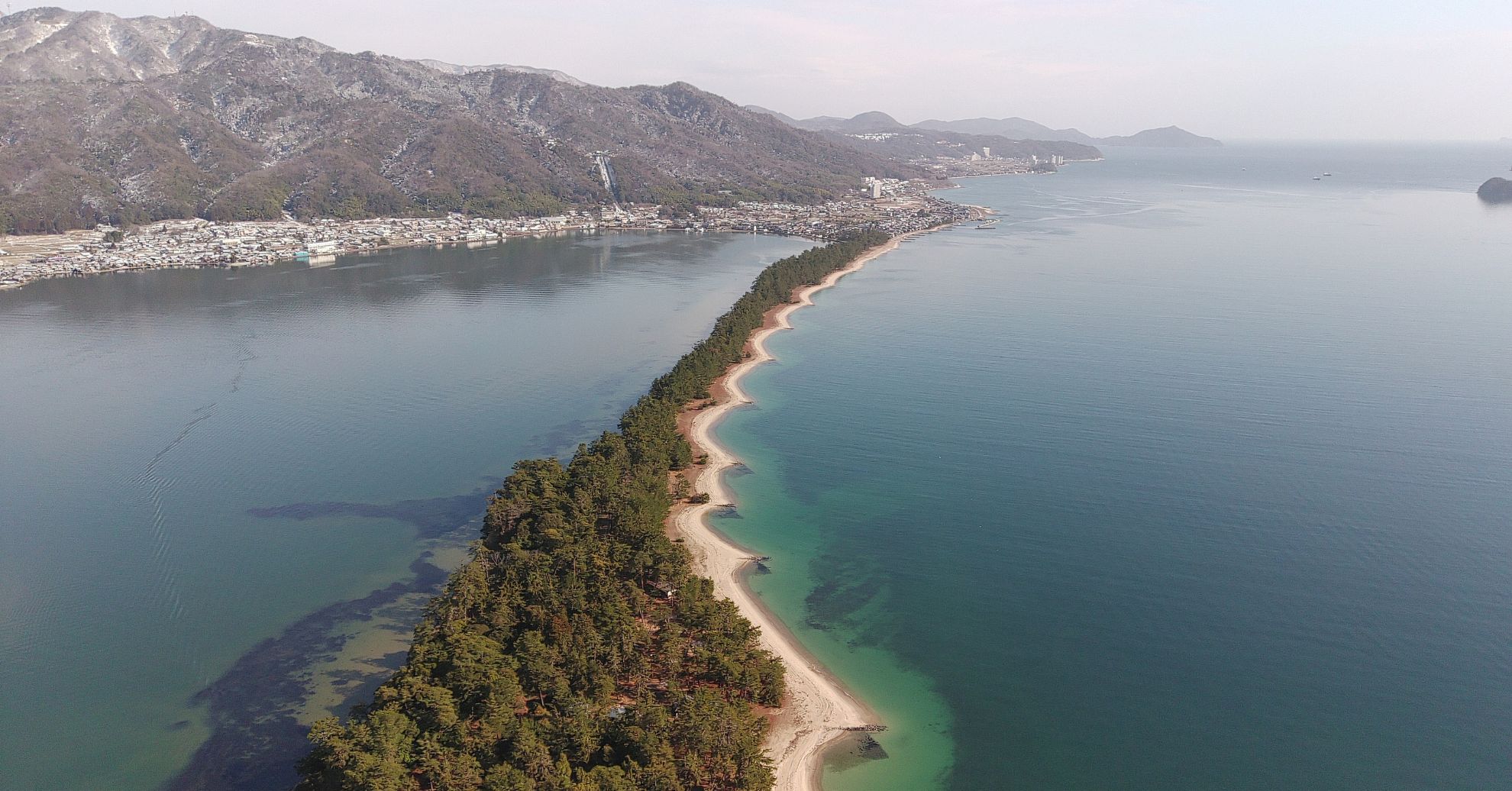

Amanohashidate is a scenic destination in the northern part of Kyoto Prefecture.
About 3.6 km long and covered with roughly 6,700 pine trees, Amanohashidate is well known as a remarkable natural landscape.
It is one of the Three Scenic Views of Japan and a designated Special Place of Scenic Beauty, and the classic way to enjoy it is matanozoki from one of the five observation points. Amanohashidate View Land is one of the most popular of these, with a particularly fine matanozoki view.
This article introduces the highlights of Amanohashidate View Land, nearby sightseeing spots and how to get there.
What Is Matanozoki?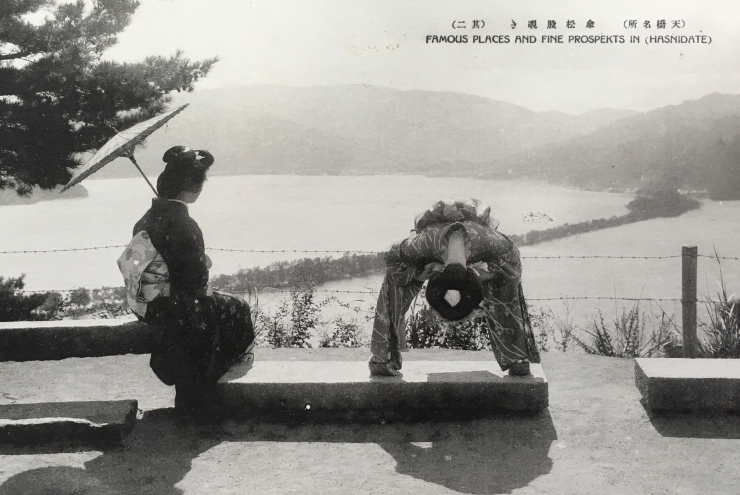
Source: https://www.city.miyazu.kyoto.jp/site/citypro/4509.html
Matanozoki means standing with your back to Amanohashidate, bending forward and looking at the view from between your legs.
Viewed this way, the sky and the sea are reversed, so that Amanohashidate looks like a bridge hanging in the sky. This is said to be how the practice took hold.
Kasamatsu Park is said to be the birthplace of matanozoki, and old photographs show maiko and geiko trying it.Matanozoki has been enjoyed for a long time.

What Is Amanohashidate View Land?
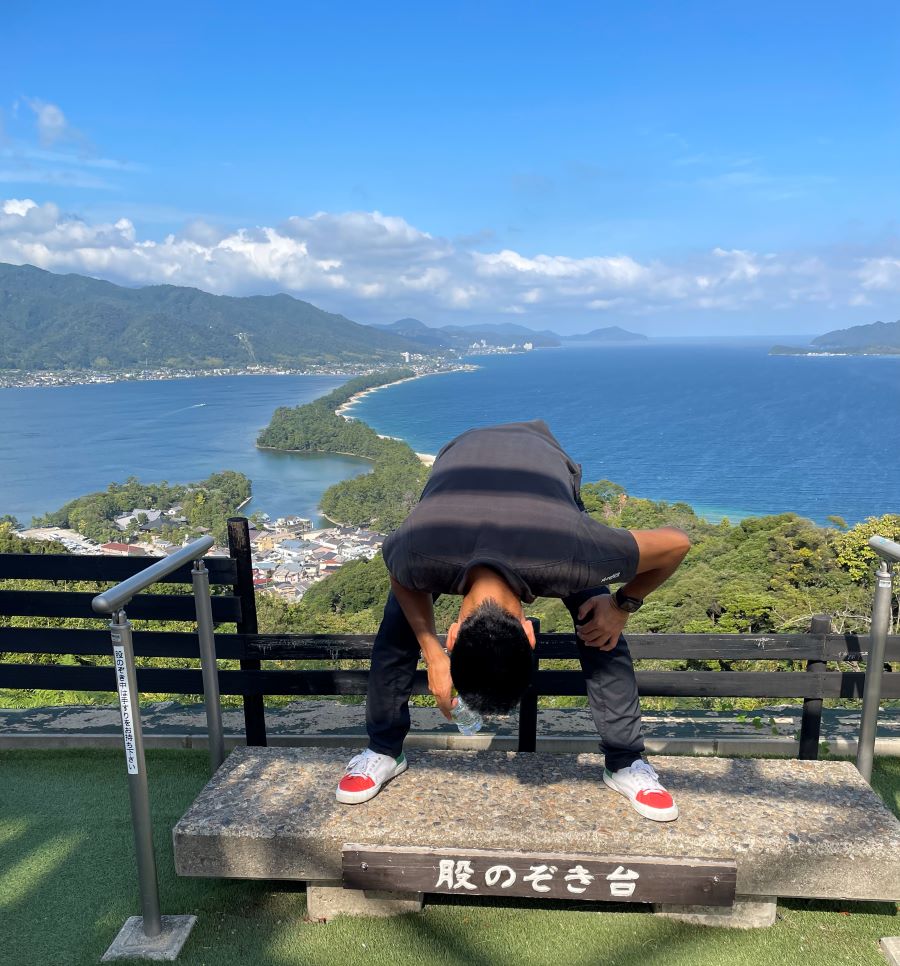
Of the five observation points in the Amanohashidate area, Amanohashidate View Land and Kasamatsu Park are the two best known for matanozoki, and both are worth visiting.
The view from Amanohashidate View Land is called Hiryukan (“Flying Dragon View”) because, seen through your legs, Amanohashidate appears to be a dragon in flight.
Besides the observation deck, Amanohashidate View Land has other viewpoints, rides and a restaurant, and facilities that families can enjoy.
Highlights of Amanohashidate View Land
Plenty of Places to Enjoy the View
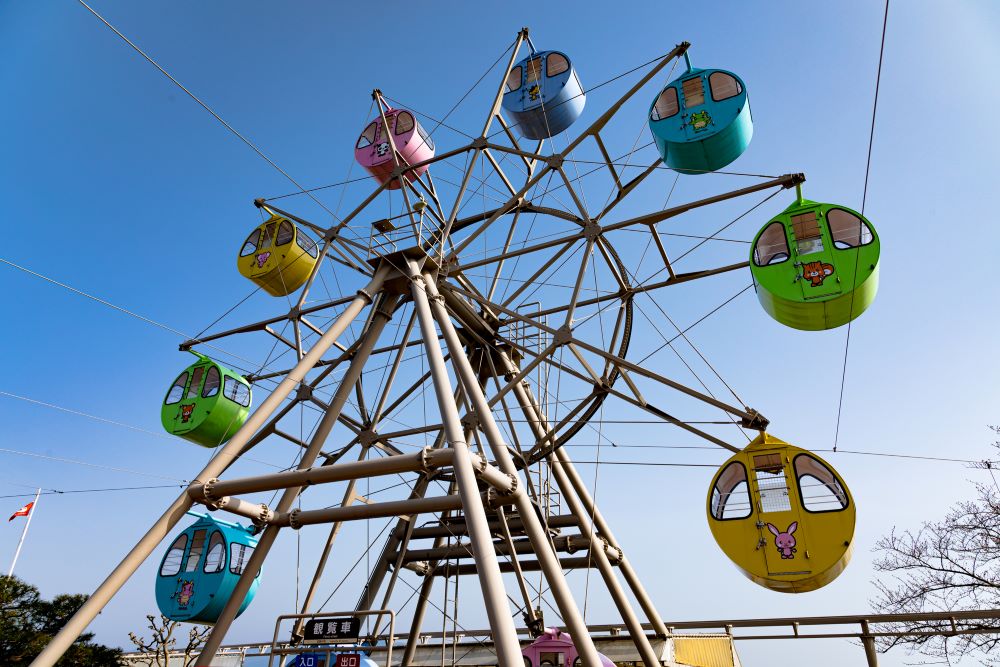
Amanohashidate View Land has seven matanozoki platforms, along with the Hiryukan Corridor modeled on the body of a dragon, a Ferris wheel, cycle cars and an observation restaurant.
The Ferris wheel is a particular highlight. It stands far higher than a Ferris wheel in a city center, so the view takes in Amanohashidate along with the town of Miyazu and the direction of Ine.
Activities for Families
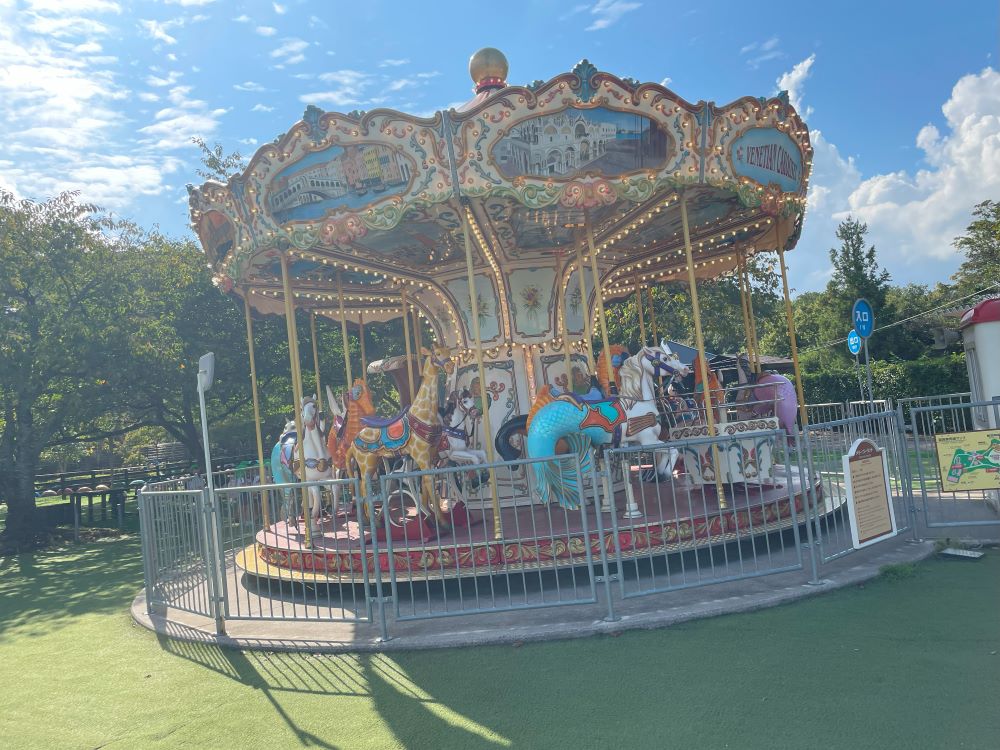
Amanohashidate View Land also has rides and activities including go-karts, a merry-go-round, coin-operated cars, the SL Benkei-go train and an archery corner.
Many of them can be enjoyed by young children as well, making this a good stop if you are visiting Amanohashidate as a family.
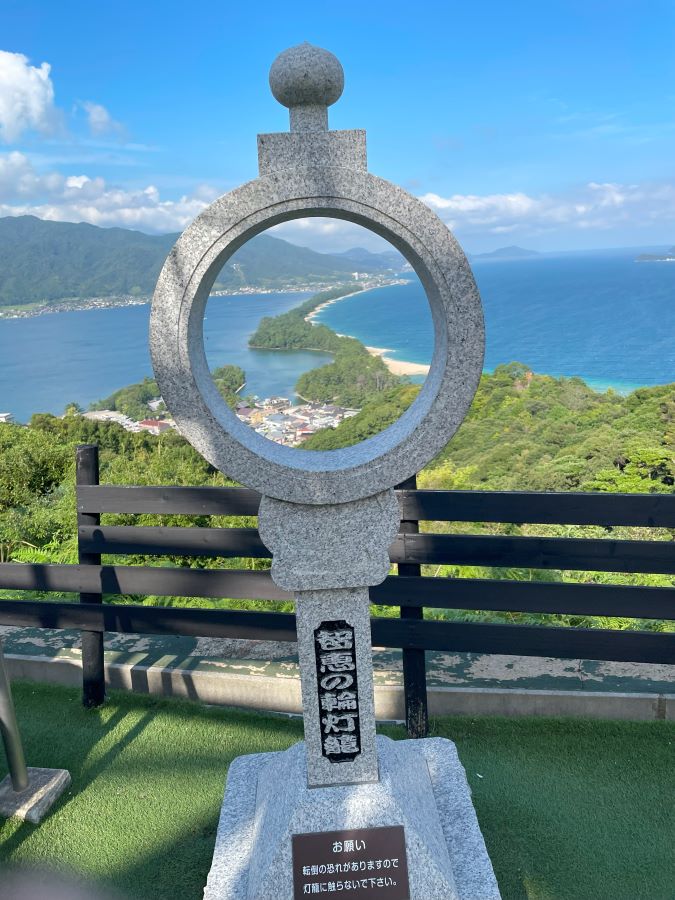
Amanohashidate is also known for kawarake-nage.
The Chie no Wa, or wisdom ring, near Chion-ji Temple is said to grant wisdom if you pass through it three times, and Amanohashidate View Land has its own Chie no Wa.
Aim for the ring when you throw your kawarake; if it passes through, your wish may come true.
As well as the round ring, there is a heart-shaped one.
If your wish concerns love, try the heart-shaped ring.
What Is Kawarake-nage?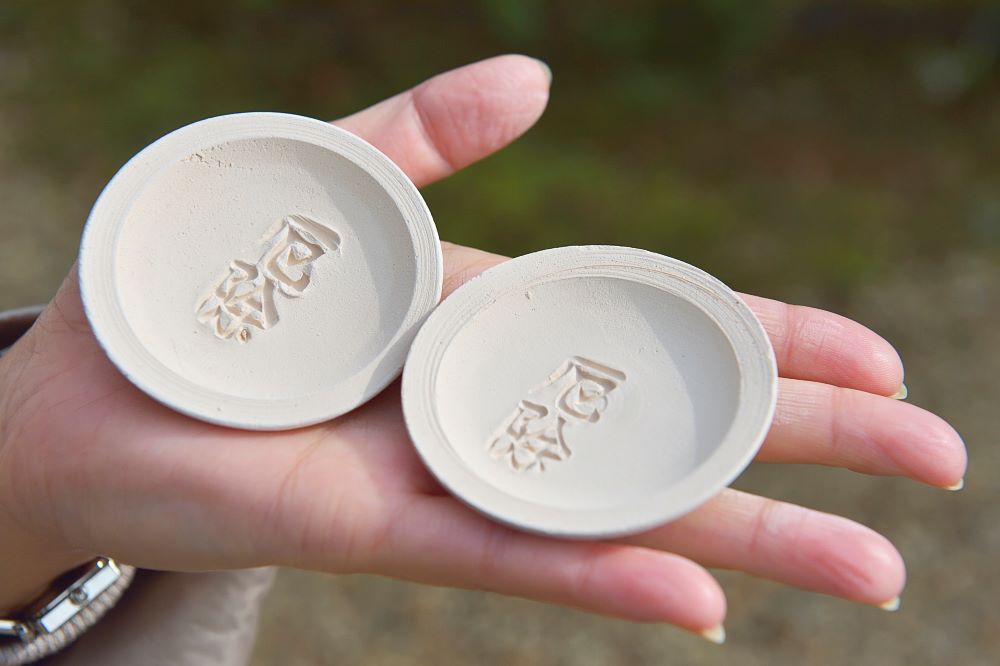
Kawarake is a small, disc-shaped piece of unglazed pottery.
In this custom, you make a wish, often to ward off bad luck, and throw the disc. It is said to have originated in the Sengoku period, when military commanders would pray for victory and throw their sake cups to the ground before setting out for battle.
It later became a popular pastime at festivals and celebrations.Whether you have a wish to be granted or want to shake off bad luck, it is worth trying.
Seasonal Views Worth Seeing
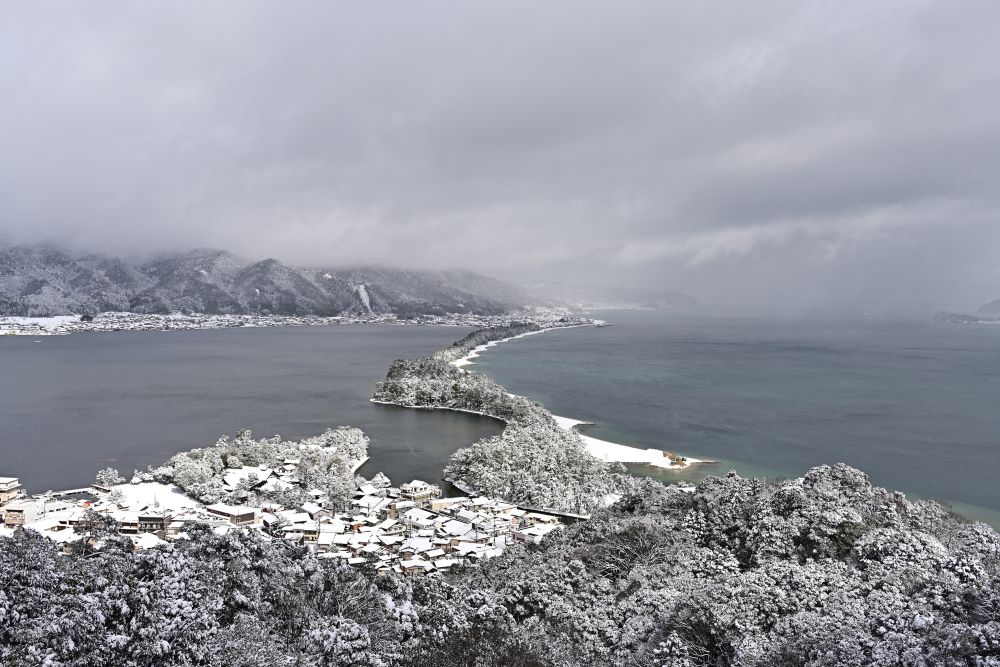
The view of Amanohashidate from Amanohashidate View Land is beautiful at any time of year, but it is especially striking in the cold of winter.
Early in the morning, fresh snow settles on the pine needles and Amanohashidate appears dressed in white. The snow is said to disappear once the sun rises.
Because it can be seen only briefly, this view is known as Gensetsu no Hiryukan, the “Flying Dragon in Fleeting Snow”.
| Amanohashidate View Land Address: Monju, Miyazu, Kyoto Prefecture Tel: 0772-22-1000 Hours: Between 8:30 and 18:00, varying by season Closed: No regular closing days Official website: https://www.viewland.jp/ |
How to Get to Amanohashidate View Land
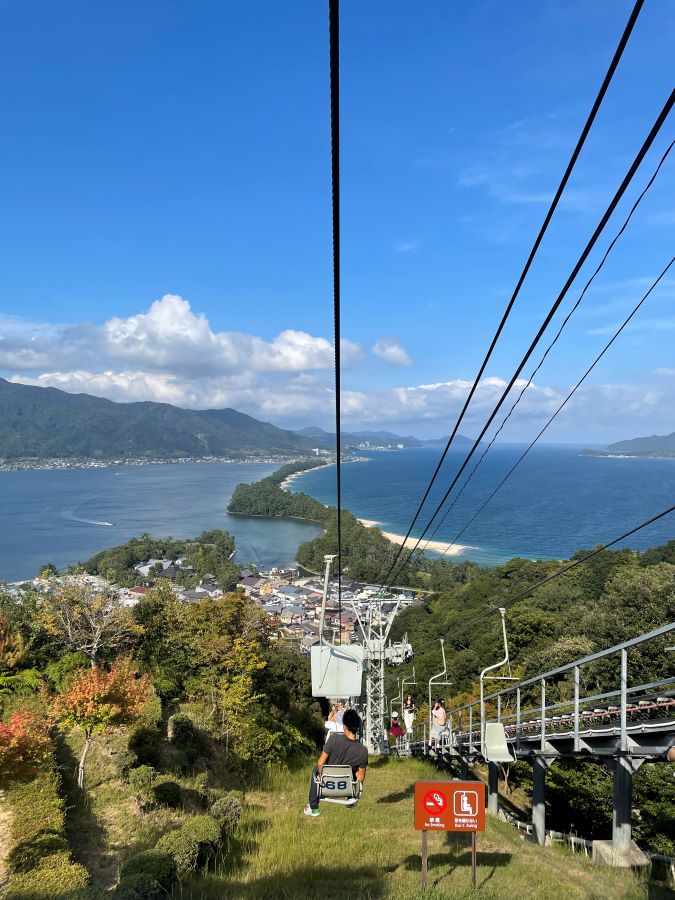
If you arrive by train or highway bus, walk about 5 minutes from Amanohashidate Station to the Amanohashidate View Land chairlift and monorail base station, then take the chairlift or the monorail up.
The monorail departs at 00, 20 and 40 minutes past the hour, and the chairlift can be boarded at any time.
Both take about 7 minutes.
One good approach is to take the monorail up and the chairlift down.
Amanohashidate, the sea and the streets of Miyazu look beautiful from the chairlift, so you can enjoy the view on the way down as well.
Approximate travel times to Amanohashidate from Kyoto, Osaka and Tokyo are shown below.
Travel Times to Amanohashidate Station
| Highway bus | Train (limited express) | Car | |
| From Kyoto | Approx. 2 hr 15 min | Approx. 2 hr | Approx. 1 hr 30 min |
| From Osaka | Approx. 2 hr 50 min | Approx. 2 hr 30 min | Approx. 2 hr |
| From Tokyo | Approx. 4 hr 30 min (Shinkansen + highway bus) | Approx. 4 hr 25 min (Shinkansen + limited express) | Approx. 6 hr 30 min |
If you come by car, there is parking in front of the Amanohashidate View Land base station and in the surrounding area.
this page has detailed information on parking.



Sightseeing Spots Near Amanohashidate View Land