
The cherry blossom season is nearly here.
Many people plan their visit around it, pairing the blossoms with shrines and temples.
According to the cherry blossom forecast that Japan Meteorological Corporation publishes each year, Kyoto usually opens in late March and reaches full bloom in early April.
That is not a convenient window for everyone, and some travelers would rather not be in the busiest places at the busiest time.
Kyoto has places where the cherry blossoms last into early May, and quieter spots that are not widely known.
This article picks out the places in Kyoto that are at their best from the middle of April into early May, and sets them out as a four-day route with three nights.
It also covers evening lighting, special spring openings, and cafes and restaurants nearby.

Day 1

Day 1 walks through Kyoto Gyoen, which holds many varieties of cherry tree, then takes the Okazaki Sakura Kairo Jikkokubune boat tour.
After that comes Heian Jingu, known for its red weeping cherries.
Kyoto Gyoen ▶ The Mikurumagaeshi Cherry, Worth Turning Back For


Across the wide grounds of Kyoto Gyoen, more than 1,000 cherry trees bloom from the middle of March into late April.
The Mikurumagaeshi cherry in front of the Gishumon gate comes into its own in early April. It is named after Emperor Go-Mizunoo, who is said to have turned his carriage back for another look at it.
Toward late April the kasumizakura blooms in Haha to Ko no Mori, the forest near the Kyoto State Guest House in the northeast of the grounds. The name comes from the way the scattered blossoms on a spring hillside look like mist.
The old names for the cherry varieties are worth reading for their own sake.
Elsewhere in the grounds you will find trees at every stage, from petals falling to leaves coming out. Take your time and look at the differences in color and in how far along each tree is.
Kyoto Gyoen
Address: Kyoto Gyoen, Kamigyo-ku, Kyoto
Tel: 075-211-6364
Website: https://fng.or.jp/kyoto/
Instagram: https://www.instagram.com/kyotogyoen_info/
Lunch ▶ Kyoto Gyoen Nakadachiuri-mon Higaki


Source: https://nakadachiuri.jp/restaurant/
After a long walk through the grounds, have an early lunch inside Kyoto Gyoen.
Kyoto Gyoen Nakadachiuri-mon Higaki, in the Nakadachiuri rest house, serves Kyoto home cooking. The set meals run to a shokado bento, grilled eel, Kyoto chirashi sushi and a sea bream chazuke with sesame miso.
The serving dishes and the way the food is arranged say a good deal about how Kyoto treats a guest.
Kyoto Gyoen Nakadachiuri Rest House
Address: 3 Kyoto Gyoen, Kamigyo-ku, Kyoto
Tel: 075-223-2550
Hours
Rest house: 8:00–18:30 (to 20:00 on Saturdays and Sundays)
Shop: 9:00–16:30
Restaurant: 8:00–18:00 (last order)
Set meals and light meals are served during restaurant hours
Website: https://nakadachiuri.jp/
Instagram: https://www.instagram.com/kyotogyoen_resthouse/
Okazaki Sakura Kairo Jikkokubune ▶ Falling Petals Seen from a Boat

The Okazaki area lies northeast of Kyoto Station. Along with Heian Jingu and Nanzen-ji it holds the Kyoto City Kyocera Museum of Art and the National Museum of Modern Art.
It also offers several ways to see the cherry blossoms, including the Keage Incline and the Okazaki Sakura Kairo Jikkokubune boat tour taken here.
The Jikkokubune runs 1.5 kilometers one way along the Okazaki canal, part of the Lake Biwa Canal, in about 25 minutes.
Petals falling onto the water from both banks are a sight you can only see at this time of year. Take it slowly from the boat.
Okazaki Sakura Kairo Jikkokubune
Address: Nanzenji Kusagawa-cho, Sakyo-ku, Kyoto
Tel: 075-353-2511 (Kyoto Prefecture Travel Agents Cooperative)
Season: usually late March to mid-April (check the official site)
Departures: every 15 minutes between 9:30 and 16:30
Duration: about 25 minutes
Fare: 2,000 yen for adults (junior high and above), 1,000 yen for elementary school children, 500 yen for children aged 3 and over
Details: https://kyoto-tabi.or.jp/tour/
Instagram: https://www.instagram.com/kyoto_travel_industry_coop/?hl=ja
Cafe ▶ Rokuro


Rokuro is one to visit if you like matcha.
It is a cafe and tea shop run by Iroku-en, a Kyoto tea merchant trading since 1818, selling Uji matcha chosen by the house along with green tea, black tea and hojicha grown without agrochemicals.
Walk in and the smell of tea leaves comes first, then the rows of antique cups and bowls.
Jo Inoue, the chairman of Iroku-en, collected Japanese antiques and European pieces, and they ended up in the cafe. Matcha is whisked in front of you in one of those antique bowls.
The sweets are made with selected matcha, and the depth of the tea, the way it melts and the restrained sweetness all come through.
Iroku-en also developed Japan’s first green tea bag and the first cold-brew green tea, and Rokuro sells bottled green tea at the counter.
Take one with you when you head back out to the cherry blossoms.
Rokuro
Address: 40-2 Okazaki Minamigosho-cho, Sakyo-ku, Kyoto
Tel: 075-757-4156
Hours: 10:00–18:00 (L.O. 17:30)
Closed: Tuesdays and Wednesdays
Website: https://www.kyoto-rokuro.jp/
Instagram: https://www.instagram.com/rokuro_kyoto/

Heian Jingu ▶ Red Weeping Cherries Like a Canopy


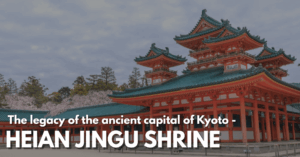
At Heian Jingu, about 300 cherry trees of some 20 varieties bloom across the wide Shin-en garden, most of them red weeping cherries.
They stand in the South and East gardens, and the novelist Junichiro Tanizaki called them a red cloud in The Makioka Sisters.
In full bloom the deep pink does read like a cloud, or a canopy overhead.
The reflection in Seiho-ike pond in the East garden, and the blossoms against the vermilion halls, are the two views people come back for.
Heian Jingu
Address: 97 Okazaki Nishitenno-cho, Sakyo-ku, Kyoto
Tel: 075-761-0221
Hours: 6:00–18:00 (varies by season; check the official site)
Website: https://www.heianjingu.or.jp/index.html
Instagram: https://www.instagram.com/heianjingu_official/
Dinner ▶ Nishijin Hashimoto


A kappo restaurant for anyone who finds that kind of place hard to walk into.
The chef and the staff make it easy from the moment you sit down.
At the counter you can watch the work and ask about it. The courses use fresh fish and whatever is in season, and the combinations are the chef’s own.
The omakase course runs from the first small dish through soup, sashimi, a grilled course, a fried course and rice cooked in a clay pot.
Nishijin Hashimoto
Address: 109 Kanze-cho, Kamigyo-ku, Kyoto
Tel: 075-203-4813
Hours: 18:00–22:00
Closed: Mondays
Website: https://www.nishijin-hashimoto.com/
Instagram: https://www.instagram.com/nishijin.hashimoto/
Day 2

Day 2 covers Kamowakeikazuchi Shrine (Kamigamo Shrine) and Kamomioya Shrine (Shimogamo Shrine), which together hold the Aoi Matsuri, one of the three great festivals of Kyoto, and Shokoku-ji, whose sub-temples include Kinkaku-ji and Ginkaku-ji. It ends with the cherry blossoms along the Kamo River and on Nene no Michi at Kodai-ji.
Kamowakeikazuchi Shrine (Kamigamo Shrine) ▶ The Saio Cherry


Kamowakeikazuchi Shrine (Kamigamo Shrine) is the oldest shrine in Kyoto and a World Heritage Site.
It was separated from the older Kamo shrine, and with Kamomioya Shrine (Shimogamo Shrine) it holds the Aoi Matsuri, one of the three great festivals of Kyoto.
The grounds are wide and there are a good many cherry trees worth stopping for.
Past the first torii gate stand the Saio cherry, a deep red weeping cherry with real presence, the white Gosho cherry, and the Miare cherry by the Hosodono hall with its two tatezuna sand cones.
There are others as well, the Furyu cherry near the second torii and the Kamo cherry by the Romon gate. Use the shrine map and compare them.
For a break, there is Koyama Yusui coffee, made with spring water that runs through the grounds.
What are the two sand cones?
Straight ahead after the second torii gate are two conical sand cones, the tatezuna. They stand for Koyama, the mountain where the deity Kamowakeikazuchi descended, and pine needles are set at the top as a marker for the deity. Look closely and the left cone has three needles and the right has two. In onmyodo, odd and even together are a wish for the deity to appear, so the two cones form a pair of yang and yin. The connection comes from the Kamo clan, who founded the shrine and practiced onmyodo.
Kamowakeikazuchi Shrine
Address: 339 Kamigamo Motoyama, Kita-ku, Kyoto
Tel: 075-781-0011
Hours
Second torii gate: 5:30–17:00
Romon gate and amulet office: 8:00–16:45
Prayer requests: 9:00–16:00
Website: https://www.kamigamojinja.jp/
Instagram: https://www.instagram.com/kamigamojinja.official/
Koyama Yusui Coffee Sen
Address: 339 Kamigamo Motoyama, Kita-ku, Kyoto
Hours
Weekdays: 10:00–16:00
Saturdays and Sundays: 10:00–17:00
Website: https://agf.ajinomoto.co.jp/feature/concept/kouyama/
Instagram: https://www.instagram.com/ko_yama_yusui.coffee/
Nakaragi no Michi and Kamomioya Shrine (Shimogamo Shrine) ▶ Cherry Blossoms in the Old Forest


Nakaragi no Michi, the path along the Kamo River between the two shrines, is well known as a cherry blossom walk.
Kamomioya Shrine stands downstream and has long been known as Shimogamo Shrine.
It enshrines the ancestral deity of the Kamo clan and has been revered as a shrine that protects the state.
It sits inside Tadasu no Mori, a stand of old forest that carries its own set of legends, which gives the grounds their atmosphere.
The Somei-yoshino beside the sazare-ishi stone at the entrance, by the Romon gate, and near the Sorihashi bridge over the Mitarashi stream are the ones to look for.
The sazare-ishi is said to house a spirit, and it appears in the words of the Japanese national anthem, which says something about the standing of this shrine.
Kamomioya Shrine (Shimogamo Shrine)
Address: 59 Shimogamo Izumikawa-cho, Sakyo-ku, Kyoto
Tel: 075-781-0010
Hours: 6:00–17:00
Closed: None
Website: https://www.shimogamo-jinja.or.jp/
Instagram: https://www.instagram.com/kamomioyajinja/
Lunch ▶ Gohandokoro Tanabeso


Source: https://tabelog.com/kyoto/A2601/A260302/26008361/dtlmenu/lunch/
Tanabeso has made miso and pickles for 150 years, working with Kyoto vegetables and whatever is in season.
Its restaurant serves set meals built around sushi made with Kyoto pickles, saikyo-yaki grilled fish, and dengaku.
The one to order is the Kyoto pickle sushi and saikyo-yaki set, which gives you both. For 330 yen more the fish becomes black cod.
Gohandokoro Tanabeso
Address: 218 Seiryu-cho, Kamigyo-ku, Kyoto
Tel: 075-213-3559
Hours
Lunch: 11:30–15:00 (L.O. 14:30)
Dinner: 17:00–19:00 (L.O. 18:00)
Closed: Wednesdays
Tanabeso pickles and miso: https://www.tanabeso.jp/
Gohandokoro Tanabeso: https://tabelog.com/kyoto/A2601/A260302/26008361/
Instagram: https://www.instagram.com/tanabeso1875/
Shokoku-ji ▶ The Kokonoe Cherry and the Crying Dragon

Shokoku-ji is the head temple of the Shokoku-ji branch of Rinzai Zen and second of the five great Zen temples of Kyoto.
Kinkaku-ji and Ginkaku-ji are among its sub-temples. It was founded by Yoshimitsu Ashikaga, the third shogun of the Muromachi shogunate, with the Zen monk Muso Soseki as its first abbot.
In the garden behind the Hojo, north of the Hatto hall, stands the Kokonoe cherry, a weeping cherry about 400 years old. Its trunk measures 4.4 meters around and its branches reach up to 20 meters.
It is protected as a National Natural Monument.
Special Spring Opening

Source: https://ja.kyoto.travel/event/single.php?event_id=4089
Shokoku-ji holds a special spring opening. It is a rare chance to see the Hatto hall with its Banryu-zu dragon by Mitsunobu Kano, along with the Hojo and the Kaisando.
Banryu means a dragon coiled and rising to the sky, and this one meets your eye from anywhere in the hall.
The ceiling is built to rise toward the center, so a clap of the hands comes back as a reverberation, as though the dragon were calling. It is known as the crying dragon.
Special spring opening
Period: usually late March to early June (check the official site)
Hours: 10:00–16:30 (last entry 16:00)
Hours differ on some days
Admission: 1,000 yen for adults, 500 yen for students
Details: https://ja.kyoto.travel/event/single.php?event_id=4089
Shokoku-ji
Address: 701 Shokokuji Monzen-cho, Imadegawa-dori Karasuma Higashi-iru, Kamigyo-ku, Kyoto
Tel: 075-231-0301
Hours: 10:00–16:00
Closed: None
Website: https://www.shokoku-ji.jp/
The Kamo River Bank ▶ A Slow Walk Along Hana no Kairo


About 25 minutes by bus from Shokoku-ji, near Sanjo Station, head for the stone marker reading Hana no Kairo on the Kamo River bank by Sanjo-ohashi bridge.
When the red weeping cherries and Somei-yoshino are at their fullest the path reads as a tunnel, and it is a good stretch to walk slowly.
Hana no Kairo
Address: Ohashi-cho, Higashiyama-ku, Kyoto
Tel: 075-701-0101 (Kyoto Prefecture Kyoto Civil Engineering Office)
Website: https://www.pref.kyoto.jp/koen-annai/kamo.html
Nene no Michi and Kodai-ji ▶ Weeping Cherries That Suit Wabi-Sabi


Kodai-ji was founded by Kita-no-Mandokoro, known as Nene, the wife of Hideyoshi Toyotomi, after his death.
The lane past Entoku-in, where Nene spent her later years, is called Nene no Michi.
Somei-yoshino and red weeping cherries line it, and together with the stone paving and the 46-meter Yasaka Pagoda at Hokan-ji it makes one of the best views in the city.
Follow Nene no Michi and Kodai-ji comes into sight. Each spring the temple holds a special evening opening.
Kodai-ji has about 50 cherry trees, including Somei-yoshino, weeping cherries and the Kodai-ji cherry, and the evening opening lights the weeping cherry in the front garden of the Hojo.
That weeping cherry in the front garden is sometimes compared to a Kyoto beauty for its composure. Watching it move in the wind is the kind of thing that stops you where you stand.
A dry garden built on the Zen view of the world
The front garden of the Hojo at Kodai-ji is a karesansui, a dry garden. The form grew out of Zen and stands for wabi-sabi, using stone, sand and plants rather than water to suggest the movement of water. The wave lines drawn in the white sand, the samon, stand for waves but also for enlightenment and for the spiral that encloses the universe. Zen monks rake the samon as a way of settling the mind. Sit with the garden for a while and see what it does.
Special spring evening opening
Period: usually mid-March to early May (check the official site)
Hours: from 17:00, last entry 21:30
(gates close at 22:00)
Lighting from 17:00
Admission: 600 yen (includes the museum)
Details: https://ja.kyoto.travel/event/single.php?event_id=4096
Kodai-ji
Address: 526 Kodaiji Shimokawara-cho, Higashiyama-ku, Kyoto
Tel: 075-561-9966
Hours: 9:00–17:30 (last entry 17:00)
Website: https://www.kodaiji.com/index.html
Instagram: https://www.instagram.com/kodaiji_zen_temple/
Day 3

Day 3 takes in the quieter cherry blossom spots in the city.
Shiramine Jingu, the shrine of kemari, Josho-ji, tied to the courtesan Yoshino Tayu, and Haradanien, where the blossoms come close enough to touch, all carry something of the history as well as the trees.
Shiramine Jingu ▶ Ukon and Nadeshiko Cherries Away from the Crowds


At Shiramine Jingu the ukon cherry, which shifts from a pale gold to white and pink, grows alongside nadeshiko cherries and yae-zakura, and they set off the kemari ground and the main hall.
Shiramine Jingu enshrines Seidai Myojin, the guardian deity of the ball, and the Asukai family, hereditary masters of kemari and of poetry, kept the rites here. It draws people who play ball sports or do gymnastics.
Because kemari is a game of not letting the ball drop, it has also come to mean not failing an exam, and students come here before their entrance exams.
The spring festival is held on April 14 each year, with a kemari offering and a chance to try the game. The ukon cherries are usually at their fullest then, which makes the grounds livelier still.
If the timing works, it is worth going.
Shiramine Jingu
Address: 261 Asukai-cho, Imadegawa-dori Horikawa Higashi-iru, Kamigyo-ku, Kyoto
Tel: 075-441-3810
Hours: 8:00–17:00
Website: https://shiraminejingu.or.jp/
Instagram: https://www.instagram.com/shiramine_jingu/
Josho-ji ▶ The Cherry Trees of Yoshino Tayu

Josho-ji stands in the north of the city, near Genko-an, which is known for its autumn leaves.
Through the vermilion Yoshino gate, in deep greenery, are about 100 cherry trees, Somei-yoshino, yae-zakura and weeping cherries among them. Few people know it.
The Yoshino of the gate is Yoshino Tayu, the highest-ranked courtesan of the early seventeenth century, known for both looks and learning.
She entered service at seven as a kamuro, a trainee, and rose to tayu, the highest rank, at fourteen. She was accomplished in tea, flower arranging and poetry, and was said to be modest and generous.
She followed Nichiren Buddhism and donated a red gate to Josho-ji, a Nichiren temple. The gate was named the Yoshino gate.
On the second Sunday of April the temple holds the Yoshino Tayu Hana Kuyo in her memory. A tayu of the present-day Shimabara quarter walks in procession in a formal uchikake robe.
Josho-ji
Address: 1 Takagamine Kitatakagamine-cho, Kita-ku, Kyoto
Tel: 075-492-6775
Hours: 8:30–17:00
Website: http://tsakae.justhpbs.jp/joshoji/toppage.html
Lunch ▶ Wakadori


Source: https://www.shozan.co.jp/restaurant/wakadori.html
Shozan Resort spreads below Takagamine, Washigamine and Amagamine, the three peaks that define northern Kyoto. It holds gardens, restaurants and a wedding hall.
Wakadori, its chicken restaurant, serves Japanese food in a villa that keeps the feel of a Kyoto machiya.
The weekend and holiday lunch menu is the broader one, though the weekday menu includes the fried chicken set with the house sauce and the chicken cutlet set with a savory sauce.
Eat looking out at the garden.
Wakadori
Address: 47 Kinugasa Kagamiishi-cho, Kita-ku, Kyoto (Shozan Resort)
Tel: 075-491-5101 (10:00–19:00)
Hours
Lunch: 11:30–14:30 (L.O. 14:00)
The weekend and holiday lunch menu is the broader one
Dinner (daily): 17:00–22:00 (L.O. 21:30)
Closed: Mondays and Thursdays (open when the day falls on a public holiday, closed the following day)
Website: https://www.shozan.co.jp/restaurant/wakadori.html
RESERVATION
Haradanien ▶ Walking Into a World Made of Cherry Blossom


Haradanien is about as quiet as cherry blossom viewing in Kyoto gets. It is a garden inside a privately owned farm, open to the public only during the cherry blossom season.
More than 400 trees of over 20 varieties grow across roughly 13,000 square meters. Some of the weeping cherries hang almost to the ground.
Deep pink, pale pink and near-white bloom together, and the effect is close to walking into a world made only of cherry blossom.
Azaleas and rhododendrons bloom there as well.
The opening period runs from late March into late April in most years. Stalls sell drinks and dango during it, and bento can be ordered, by phone, at least two days ahead.
Please note
Haradanien is private land, and the following are not allowed.
No food or drink brought in
No photographs taken while holding or shaking the branches
No tripods, monopods or ground sheets
No bridal photography
No pets
Come by city bus, by taxi or on the shuttle bus that runs during the season. The paths are unpaved, with steps and slopes, because the garden is kept for the trees and the view. Take your rubbish with you.
Haradanien
Address: 36 Okitayama Haradani Inui-cho, Kita-ku, Kyoto
Tel: 075-461-2924
Hours: 9:00–17:00 (last entry 16:30)
Admission varies with the season; check the official site for the opening period and the fee
Cash only
Website: http://www.haradanien.com/
Instagram: https://www.instagram.com/haradanien/?hl=ja
Dinner ▶ Okonomiyaki Katsu


Source: https://tabelog.com/kyoto/A2601/A260402/26011168/
Katsu is an okonomiyaki shop near Ryoan-ji that locals have kept going.
It serves teppan dishes including yakisoba, butatama and betayaki. Betayaki is a Kyoto staple, close to okonomiyaki but not the same.
A thin crepe-like batter is topped with cabbage, spring onion and red pickled ginger, sometimes with squid or meat.
It used to be sold at sweet shops as an after-school snack. It is lighter than okonomiyaki, so it goes down easily.
The owner runs the place with real care, which is why it reviews as well as it does.
Okonomiyaki Katsu
Address: 1-4 Ryoanji Saiguu-cho, Ukyo-ku, Kyoto
Tel: 075-464-8981
Hours
Lunch: from 11:30, L.O. 13:30
Dinner: from 18:00, L.O. 21:00
Fridays are dinner only
Closed: the third Wednesday and every Thursday
Website: https://okonomiyakikatsu.wixsite.com/katsu
Instagram: https://www.instagram.com/okonomiyakikatsu/?hl=ja
Day 4

Day 4 covers Hirano Shrine, where the season runs long, and the late-blooming Ninna-ji and Nison-in.
On the way, the Randen, the only streetcar line in Kyoto, runs through a tunnel of cherry blossoms, and the Kimono Forest stands 600 yuzen pillars among the trees.
Hirano Shrine ▶ Falling Petals and Full Bloom at Once


Hirano Shrine was founded around the time the capital moved to Heian-kyo in 794. In the Heian period it was counted among the Myojin Taisha, the shrines where the presence of the deity was held to be strongest, and the court revered it.
That puts it alongside Ise Jingu and the two Kamo shrines as a shrine of the first rank.
Cherry trees were planted here as a symbol of vitality, and about 400 trees of some 60 varieties bloom in spring. The early Sakigake cherry opens in mid-March and the late Tsukubane cherry from mid-April, so the season here runs about six weeks.
You can see trees shedding petals and trees at full bloom at the same time, which is why people come back more than once.
Hirano Shrine
Address: 1 Hirano Miyamoto-cho, Kita-ku, Kyoto
Tel: 075-461-4450
Mail: info@hiranojinja.com
Hours: 6:00–17:00
Website: https://www.hiranojinja.com/
Instagram: https://www.instagram.com/hirano_jinja/profilecard/?igsh=MWZwNGs0enRuZDRs
Ninna-ji ▶ The Omuro Cherry, Kyoto’s Best Late Bloom


Kinukake no Michi is the road in northwestern Kyoto that links three World Heritage Sites: Kinkaku-ji, Ninna-ji and Ryoan-ji.
Emperor Uda, who founded Ninna-ji, is said to have wanted to see snow in summer, so white cloth was draped over Mount Kinugasa for him. The name combines the kinu of Kinugasa with kake, to drape.
Many of the late-blooming cherries grow along Kinukake no Michi, and Ninna-ji is one of them.
Ninna-ji was founded by Emperor Uda, and from then on a hoshinno, an imperial prince who had taken orders, served as its abbot. It was known as the Omuro Gosho and has long been close to the imperial house.
Past the Chumon gate at Ninna-ji stand the Omuro cherries. From the Edo period they were loved as the people’s cherry trees, and they appear in a good deal of writing.
They are short, so the blossoms are at eye level, which is part of why people come.
The Omuro Hana Matsuri runs from late March into early May in most years. Somei-yoshino, weeping cherries and the deep purplish-pink Yoko cherry grow here too, so there is plenty to compare.
Omuro Hana Matsuri special entry period
Period: usually late March to early May (check the official site)
Hours: 8:30–17:30 (last entry 17:00)
Special entry fee: 800 yen (free for high school students and younger)
The garden has a separate admission. See the HP for details.
RESERVATION
Ninna-ji
Address: 33 Omuro Ouchi, Ukyo-ku, Kyoto
Tel: 075-461-1155
Hours: 8:30–17:30 (last entry 17:00)
Website: https://ninnaji.jp/
Instagram: https://www.instagram.com/ninnajitemple/
The Randen and the Kimono Forest ▶ Through a Tunnel of Blossom to a Forest of Light


The Randen, run by Keifuku Electric Railroad, is the only streetcar line in Kyoto.
Between Narutaki and Utano on the Kitano Line, Somei-yoshino line both sides of the track and form a tunnel of blossom.
About ten minutes on foot from Randen Arashiyama Station, the terminus, is the Kimono Forest, 600 pillars wrapped in yuzen-dyed fabric. They are lit after dark.
There is also a foot bath for tired legs, the Ryu no Atago Pond, where dipping your hand in is said to bring good fortune, and the Hannari Hokkori Square with a cafe serving matcha sweets and a cosmetics shop.
Randen Arashiyama Station
Address: 20-2 Saga Tenryuji Tsukurimichi-cho, Ukyo-ku, Kyoto
Tel: 075-873-2121
Hours
1F and 3F: 10:00–18:00
2F: 11:00–18:00
Website: https://www.kyotoarashiyama.jp/about/
Lunch ▶ Kyoto Arashiyama Yoshiya
A Saga-style Kyoto restaurant that handles halal, vegan and gluten-free requests.
It has Oku no Niwa for parties of up to ten, a banquet room for larger groups, and Ranyatei for Japanese course meals.
The rooms mix Japanese and modern design, and the menu runs to tofu, yuba, udon and soba, along with eel and Omi-hime wagyu. Because the kitchen works to halal and vegan standards, people who eat differently can sit at the same table.
For something lighter, the Hondori branch sells yuba cheese, a balance of yuba, fish paste and cheese.
Kyoto Arashiyama Yoshiya
Address: 31 Saga Tenryuji Tsukurimichi-cho, Ukyo-ku, Kyoto
Tel: 075-871-0448
Hours: 11:00–17:30
Website: https://yoshiya-kyoto.jp/jp/hondori
Instagram: https://www.instagram.com/yoshiya_arashiyama/
RESERVATION
Nison-in ▶ Listening to the Cherry Blossoms Move


Nison-in takes its name from the two Buddhas it enshrines, Shaka Nyorai and Amida Nyorai.
It is known as the Momiji no Baba, the maple avenue wide enough for a horse to gallop down, but it is a cherry blossom site as well. Trees line the way from the main gate to the Hondo, and the weeping cherries and the rare Fugenzo yae-zakura around the hall are the ones to see.
The Fugenzo is named for the way the two leaf-like pistils curve, which was thought to resemble the trunk of the elephant that Fugen Bosatsu rides.
With the leaves moving, the birds and the blossoms shifting in the wind, it is an easy place to slow down.
Nison-in
Address: 27 Saga Nisonin Monzen Chojin-cho, Ukyo-ku, Kyoto
Tel: 075-861-0687
Hours: 9:00–16:30
Closed: None
Website: https://nisonin.jp/
Instagram: https://www.instagram.com/nisonin/
Dinner ▶ Wagyu Donburiya Nikuni

A small wagyu restaurant in a residential street, open since May 2024. The one to order is the wagyu hitsumabushi yukke bowl, raw wagyu yukke eaten first on its own and then with a Kyoto-style dashi poured over it.
The beef is tender, and eating it raw brings out more of the flavor and sweetness. The soy-based sauce makes it easy to keep eating.
The Kyoto dashi, made fresh each morning from katsuo and kombu, gives the second half a different character. It is good enough to drink on its own.
Nikuni is certified by the public health office to serve raw meat, so the yukke is prepared under that standard.
Besides the yukke there are wagyu hamburg steak, simmered beef tendon and wagyu steak.
Single dishes such as shiba-zuke potato salad and dashimaki tamago also work alongside a drink.
Wagyu Donburiya Nikuni
Address: 3-19 Arashiyama Higashiichikawa-cho, Nishikyo-ku, Kyoto
Tel: 080-3837-6943
Hours: 11:00–21:30 (L.O. 20:30)
Mondays: 11:00–15:00
Closed: Tuesdays
Reference: https://tabelog.com/kyoto/A2601/A260403/26041262/
Instagram: https://www.instagram.com/wagyuya_nikuni/
Kyoto Pleasant Hotel: Games and Manga on Site


Here are two places to stay in the city that work well for the route above.
Kyoto Pleasant Hotel is easy to reach from Kyoto Gyoen, Shiramine Jingu and Hirano Shrine. It has an arcade corner and a manga library on site.
The games run from old favorites to current titles, and the manga library holds about 3,000 volumes, so there is a fair chance of finding something you read years ago.
Events run through the year, so it also suits travelers who want something to do without going out.
Kyoto Pleasant Hotel
Address: 857 Kitafunabashi-cho, Horikawa-dori Imadegawa-agaru, Kamigyo-ku, Kyoto
Tel: 075-366-6711
Mail: info@kyoto-pleasanthotel.com
Website: https://kyoto-pleasanthotel.com/
Instagram: https://www.instagram.com/pleasant_hotel/
Denshin-an: A Traditional Rental Villa for One Group a Day


Source: https://www.denshinan.jp/
Denshin-an stands near Ninna-ji, in the Kinukake no Michi area.
It is a hundred-year-old rental villa that was once the detached wing of a private house. One group a day, up to five people, so it suits couples, families or friends who want the place to themselves.
The name carries the wish to pass on the spirit of Kyoto, and the city has designated it one of its Buildings and Gardens That Give Kyoto Its Character, a building worth keeping for its history.
The tatami rooms keep their old form, but the house has been renovated, with underfloor heating in every room including the kitchen, bath and toilet.
You can eat at the restaurants nearby or bring ingredients and cook in the kitchen.
Denshin-an
Address: 30 Ryoanji Nishinokawa-cho, Ukyo-ku, Kyoto
Tel: 075-464-7652
Website: https://www.denshinan.jp/
Instagram: https://www.instagram.com/denshin_an?igshid=1lpz7yn2rk3wy
Summary
This article set out a four-day route through Kyoto for the cherry blossom season.
The best-known places fill up, but the quieter spots and the larger grounds give you room to look.
Kyoto can reach 20 degrees at this time of year, which is comfortable, though evenings turn cold, so bring a light jacket or a cardigan.
You will be on your feet a great deal, so wear shoes you can walk in.
Enjoy the cherry blossoms in Kyoto.